
From Blaming Opposition to Blaming Citizens: APC’s Conflicting Explanations for Hunger
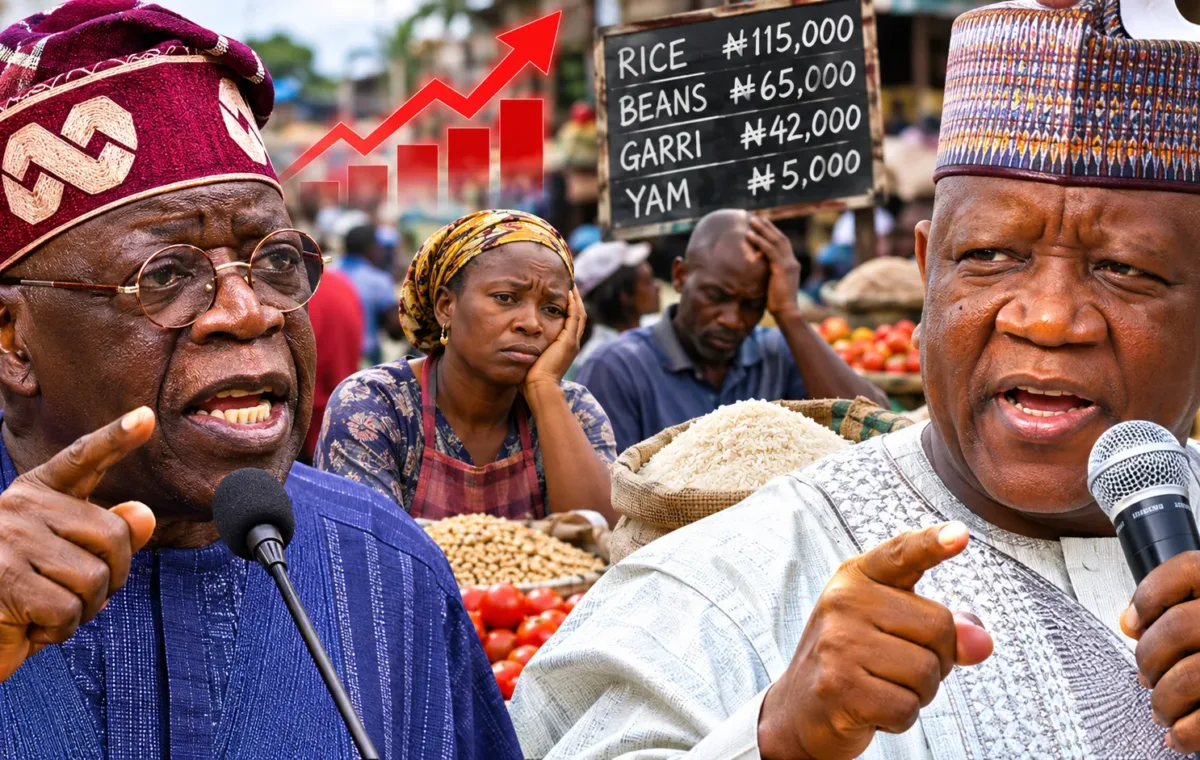
Nigeria’s worsening cost-of-living crisis has taken another political turn, with President Bola Ahmed Tinubu blaming opposition politicians for the hunger confronting Nigerians, while his Presidential Campaign Council Director-General, Senator Abdulaziz Yari, has made remarks suggesting that Nigerians who work hard should be able to afford food.
The contrasting explanations from two prominent figures in the ruling All Progressives Congress (APC) have raised questions about the party’s understanding of the economic difficulties facing ordinary Nigerians and its willingness to accept responsibility for the country’s economic situation.
At a time when millions of households are struggling with rising food prices, declining purchasing power and increasing living costs, Nigerians are being presented with two explanations: the opposition is responsible for the hunger, or citizens need to work harder to feed themselves.
But where exactly does the responsibility of the government begin and end?
TINUBU POINTS FINGERS AT THE OPPOSITION
Speaking at the APC presidential campaign flag-off in Kaduna on October 24, President Tinubu accused opposition politicians of creating the hunger and poverty they now criticise his administration over.
“I have heard my opponents talking about hunger and poverty. Who caused them? They did! They caused hunger and poverty. We are trying to eliminate them,” the President declared.
The statement effectively shifted responsibility for the country’s economic difficulties towards political opponents, even as his administration continues to defend its economic policies as necessary reforms for long-term recovery.
However, the President’s argument raises an important question: if the opposition is responsible for the hunger Nigerians are experiencing, what responsibility does an administration that has been in power since May 2023 bear for addressing it?
Opposition parties may have governed Nigeria at different times, and previous administrations undoubtedly contributed to the country’s structural economic problems. But the responsibility to govern and implement solutions currently rests with the Tinubu administration.
YARI’S EXPLANATION: ARE NIGERIANS NOT WORKING HARD ENOUGH?
The conversation took another dimension during the APC campaign rally in Uyo, Akwa Ibom State, on Friday, November 6, when Senator Abdulaziz Yari, the Director-General of Tinubu’s Presidential Campaign Council, made comments about hunger and food availability.
Yari acknowledged the existence of hunger but questioned the complaints of Nigerians, arguing that food was available in markets.
He questioned whether anybody had taken money to the market and failed to find rice to buy, while suggesting that hardworking Nigerians should be able to put food on their tables.
His remarks have attracted attention because they appear to place part of the explanation for Nigerians’ inability to afford food on their individual work ethic.
This introduces an interesting contradiction within the ruling party’s messaging.
While the President points towards the opposition as the cause of hunger, his campaign Director-General appears to suggest that Nigerians themselves may need to work harder to overcome their difficulties.
Are Nigerians hungry because the opposition allegedly created the problem, or because they are not working hard enough?
And if both arguments are being advanced by the same political establishment, what exactly is the APC asking Nigerians to believe?
THE DIFFERENCE BETWEEN FOOD AVAILABILITY AND AFFORDABILITY
Perhaps the most important issue overlooked in Yari’s argument is the distinction between food availability and food affordability.
The presence of rice, beans, garri and other food commodities in markets does not automatically mean that ordinary Nigerians can afford them.
A market may be adequately stocked while households lack the purchasing power to buy sufficient food.
The real question is not whether rice is available for sale. It is whether a Nigerian earning a modest salary, operating a small business or surviving on irregular income can comfortably afford to feed a family.
A civil servant whose salary has failed to keep pace with inflation, a petty trader whose capital has been weakened by rising costs, and an unemployed graduate may all have access to the same market.
But access to food markets does not translate into the ability to purchase food.
Hard work is important, but it does not automatically guarantee financial security, particularly in an economy where the cost of basic necessities can rise faster than household incomes.
Millions of Nigerians work daily and still struggle to meet their most basic needs. Their circumstances cannot simply be reduced to laziness or a lack of commitment to work.
THE ECONOMIC REFORMS AND THE QUESTION OF ACCOUNTABILITY
Since assuming office in May 2023, President Tinubu has implemented major economic reforms, including the removal of the petrol subsidy and changes to the foreign exchange regime.
The administration has consistently defended these decisions as necessary steps towards addressing longstanding economic distortions and creating a more sustainable economy.
However, the reforms have also had significant consequences for transportation costs, food distribution, household spending and purchasing power.
While the government has repeatedly promised that the reforms will eventually deliver economic benefits, Nigerians are entitled to demand evidence of those benefits in their daily lives.
It is not enough to tell citizens that the economy is improving if their incomes cannot adequately cover food, transportation, electricity and other essential expenses.
Neither can the government indefinitely rely on the failures of previous administrations to explain the difficulties citizens continue to experience under its watch.
The APC has governed Nigeria since 2015. President Tinubu has been in charge of the executive arm since May 2023.
The responsibility to explain the outcomes of government policies therefore cannot be transferred entirely to the opposition.
THE OPPOSITION IS NOT THE GOVERNMENT
In a democracy, opposition parties have a responsibility to scrutinise government policies, challenge decisions and present alternative solutions.
Their criticisms may sometimes be politically motivated, exaggerated or even inaccurate. Such claims should be examined on their merits.
However, criticising the government does not automatically make the opposition responsible for the economic conditions being criticised.
Equally, citizens who complain about hunger are not necessarily unwilling to work.
The government must distinguish between political criticism and legitimate public dissatisfaction.
When citizens complain that food has become unaffordable, the appropriate response should be to examine the economic realities behind those complaints and explain what is being done to address them.
Reducing the conversation to political blame or individual work ethic risks diverting attention from the policies and practical interventions required to improve living conditions.
NIGERIANS DESERVE MORE THAN EXPLANATIONS
As the APC intensifies its political mobilisation ahead of the 2027 general elections, the ruling party must understand that Nigerians will not judge its performance merely by campaign speeches or explanations about who caused the country’s economic difficulties.
They will judge it by the cost of food, the value of their incomes, the availability of jobs, the reliability of electricity and the general quality of life.
They want to know what is being done to reduce food prices, improve local agricultural production, strengthen the naira, create sustainable employment and restore purchasing power.
They also want measurable evidence that the sacrifices demanded of them are producing tangible benefits.
President Tinubu cannot simply blame the opposition for hunger and expect Nigerians to forget that he is the incumbent President.
Similarly, his campaign Director-General cannot suggest that the solution to widespread economic hardship is simply for citizens to work harder without adequately addressing the realities of wages, inflation and purchasing power.
The opposition may have its own record to defend, and individual productivity remains important to economic development. But neither issue absolves the government of its responsibility to govern.
Ultimately, the contradiction between blaming the opposition and questioning the work ethic of hungry citizens presents an important question for the APC:
If the opposition caused the hunger and Nigerians are expected to work harder to overcome it, what exactly is the responsibility of the government?
For millions of struggling households, the answer will not be found in another campaign speech.
It will be found in affordable food, better incomes, employment opportunities and tangible improvements in their standard of living.
Nigerians are not merely asking who caused their hunger. They are asking who will make life affordable again.