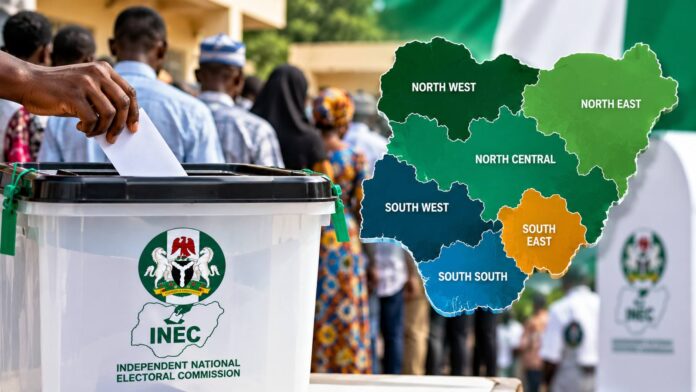
The North-West and South-West geopolitical zones have emerged as Nigeria’s largest voting blocs ahead of the 2027 general elections, while the South-East has the lowest number of registered voters, according to the latest figures released by the Independent National Electoral Commission (INEC).
Nigeria’s national voter register now stands at 103,428,715 registered voters.
The North-West accounts for 25,083,411 voters, representing about 24.25 per cent of the national register.
The South-West follows with 19,614,274 voters, representing 18.96 per cent.
Together, both zones account for 44,697,685 registered voters, representing more than 43 per cent of Nigeria’s total voter population.
South-East records lowest figure
The South-East has 11,976,218 registered voters, representing 11.58 per cent of the national register.
North-Central has 16,965,787 registered voters, while the South-South has 15,823,550.
The North-East accounts for 13,965,475 registered voters.
At the state level, Lagos leads the country with 7,488,633 registered voters.
Kano follows with 6,570,276, while Kaduna ranks third with 4,662,640.
Katsina and Rivers complete the top five with 3,876,051 and 3,736,434 registered voters respectively.
Voters aged 18–49 dominate register
The figures also show that voters between the ages of 18 and 49 constitute more than 73 per cent of the national register.
Voters aged 35 to 49 form the largest age group with 43,265,946 registered voters, representing 41.83 per cent.
Those aged 18 to 34 account for 29,777,578 voters, or 28.79 per cent.
The new register represents an increase of nearly 10 million voters compared with the approximately 93.47 million registered voters recorded for the 2023 general elections.
The distribution of registered voters is expected to remain a major factor in political mobilisation and campaign strategies as parties prepare for the 2027 elections.