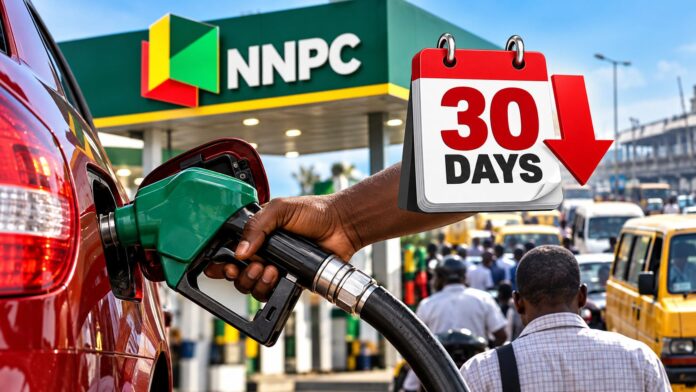
The Federal Government’s announcement of a 30-day petrol discount through Nigerian National Petroleum Company Limited (NNPC) retail outlets has reopened an important debate about the cost of living, the effectiveness of economic policies and the government’s commitment to easing the suffering of Nigerians.
The initiative, announced on October 8, 2026, is intended to cushion the impact of rising petrol prices by allowing NNPC to forgo its retail profit margin and sell petrol at cost for an initial period of 30 days, with priority given to public transport operators.
While the measure may offer some immediate relief, it raises a fundamental question: Is a 30-day discount sufficient to address years of economic hardship, or is the government offering Nigerians another temporary solution to a problem that requires lasting intervention?
For millions of Nigerians battling rising transport fares, food prices, electricity costs and dwindling purchasing power, the announcement is welcome only to the extent that it translates into tangible improvements in their daily lives.
Unfortunately, the policy, as announced, leaves several questions unanswered.
THREE YEARS OF HARDSHIP, 30 DAYS OF RELIEF
Since President Bola Tinubu announced the removal of petrol subsidy in May 2023, Nigerians have experienced significant economic adjustments, with higher fuel costs contributing to increased transportation and distribution expenses.
The government defended subsidy removal as a necessary step towards reducing the financial burden on the public treasury and redirecting resources towards national development.
However, the benefits promised by the administration have not translated into sufficient relief for many households struggling to afford basic necessities.
Businesses have faced higher operating costs, transport operators have adjusted their fares, and consumers have had to contend with the rising cost of moving goods and services across the country.
Against this background, the decision to introduce a 30-day discount raises legitimate concerns about the government’s approach to economic relief.
If the removal of subsidy was necessary to protect the economy, why has the administration not established a more comprehensive and effective framework to protect vulnerable Nigerians from its consequences?
Why should a government that has repeatedly defended its economic reforms as necessary for long-term prosperity now rely on a short-term discount to address the immediate consequences of those same reforms?
The problem is not necessarily that the government has introduced a temporary intervention. Governments must respond to changing economic circumstances.
The concern is that Nigerians deserve a clear explanation of why this intervention is being introduced now, how much relief it will deliver and what measures will follow when the 30 days expire.
THE IMPLEMENTATION QUESTIONS THE GOVERNMENT MUST ANSWER
One of the greatest weaknesses of the announcement is the uncertainty surrounding its practical implementation.
The government says NNPC will forgo its retail profit margin and sell petrol at cost. It has also discussed a proposed ceiling of ₦1,350 per litre on the ex-gantry or landing cost of petrol.
However, a ceiling on landing or gantry costs should not be confused with a guaranteed retail pump price of ₦1,350 nationwide.
The government must clearly explain how the arrangement will operate, what consumers will actually pay, and how the financial implications will be managed.
Nigerians should not be left to interpret policy announcements while filling stations continue to determine the prices motorists encounter at the pumps.
Furthermore, prioritising public transport operators does not automatically guarantee that passengers will benefit.
A commercial driver who purchases petrol at a reduced cost may decide to retain the savings rather than reduce fares. Without a credible monitoring mechanism, the intervention could benefit some transport operators without significantly improving the circumstances of the commuters the policy is supposed to help.
The government must therefore explain how it intends to ensure that lower fuel costs translate into lower transport fares.
There is also the question of accessibility.
Will the discount be available at every NNPC retail outlet? How will commercial transport operators be identified? What safeguards will prevent diversion, preferential treatment or artificial shortages? How will Nigerians in communities without convenient access to participating outlets benefit?
These are not minor administrative details. They are essential questions that determine whether a policy delivers meaningful relief or remains an announcement with limited impact.
A government serious about economic relief must do more than announce a discount. It must demonstrate that the discount is accessible, transparent and capable of producing measurable benefits.
THE POLITICAL TIMING CANNOT BE IGNORED
Perhaps the most contentious aspect of this intervention is its timing.
Nigeria is approaching the 2027 general election, and the Tinubu administration is facing public scrutiny over the economic consequences of its policies.
The introduction of a petrol discount at this stage inevitably raises questions about the relationship between economic policymaking and electoral considerations.
Why is the government introducing this measure now, after Nigerians have spent more than three years adjusting to the consequences of subsidy removal?
Could similar relief measures have been introduced earlier, when households and businesses were struggling to absorb successive increases in fuel costs?
What changed in the government’s assessment of the situation to make this intervention necessary at this particular moment?
These questions deserve answers.
The timing alone does not establish that the policy is politically motivated. However, the approaching election makes transparency and accountability particularly important.
The government must ensure that Nigerians can assess the initiative on its actual merits rather than being asked to accept it as proof of its commitment to their welfare.
Public policy should be driven by the needs of citizens, not by the demands of an electoral calendar.
If the administration believes the discount is economically justified, it should publish the evidence supporting the decision, disclose the expected benefits and explain why the intervention was not introduced earlier.
It must also demonstrate that the policy is part of a coherent economic strategy rather than an isolated response to mounting public frustration.
Nigerians should not have to wait until election season before receiving meaningful attention to the pressures affecting their livelihoods.
The credibility of any government depends not only on the relief it announces but also on the consistency with which it responds to citizens’ needs.
THE CONTRADICTION IN GOVERNMENT’S ECONOMIC APPROACH
The Federal Government has consistently argued that petrol subsidy removal was necessary to eliminate distortions in the economy and create room for more productive public spending.
Yet, the decision to forgo NNPC’s retail profit margin for 30 days demonstrates that the government recognises the need for intervention when market conditions place additional pressure on consumers.
There is no inherent contradiction in adjusting economic policy to protect vulnerable citizens. Indeed, responsible economic management requires flexibility.
However, the government must explain the principles guiding these interventions.
If temporary relief is justified now, what prevented the administration from introducing more effective cushioning measures earlier?
If the government can encourage NNPC to sacrifice its retail margin to ease hardship, what other practical measures can it implement to reduce transportation costs, improve public mobility and support small businesses?
And if the administration believes that the current intervention will produce meaningful results, what evidence will it use to measure its success?
These questions expose the need for a more consistent approach to economic management.
Nigerians should not be forced to endure prolonged hardship while waiting for the government to determine how best to translate economic reforms into tangible improvements in their lives.
Economic reforms cannot be judged solely by government revenue, fiscal savings or macroeconomic indicators. They must also be assessed by whether ordinary citizens can afford food, transportation, housing, healthcare and education.
A reform that improves government finances but leaves millions of citizens unable to meet basic needs requires complementary policies capable of addressing those consequences.
The government must demonstrate that its economic programme recognises this responsibility.
CAN 30 DAYS OF DISCOUNT AMELIORATE NIGERIANS’ SUFFERING?
The short answer is that it could provide temporary relief, but its capacity to address the wider cost-of-living crisis is limited.
Petrol prices influence transportation, logistics, small businesses and the cost of moving agricultural produce from farms to markets.
A reduction in fuel costs could therefore help reduce operating expenses for transport operators and other businesses.
If those savings are passed on to consumers, Nigerians could experience some relief in transportation and, potentially, the prices of certain goods.
However, these benefits are not automatic.
Transport fares may remain unchanged even when fuel costs decline. Food prices may continue to reflect earlier increases in production and distribution expenses. Businesses that have accumulated debts or experienced declining sales may not immediately reduce their prices.
Moreover, a discount available for only 30 days does not provide businesses with the certainty required to plan their operations over a longer period.
Households facing persistent economic difficulties need predictable improvements in affordability, not merely a temporary reduction in one component of their expenses.
The government must also recognise that the cost-of-living crisis extends beyond petrol.
Food affordability, electricity tariffs, housing costs, access to credit and the purchasing power of workers all influence the welfare of Nigerian households.
A temporary petrol discount cannot resolve these interconnected challenges.
At best, it could serve as an emergency measure while the government implements more comprehensive interventions. At worst, poor implementation could limit its benefits to a relatively small section of the population.
Its ultimate impact will depend on the size of the savings, the number of people who can access them, the response of transport operators and the policies introduced after the initial period.
WHAT HAPPENS AFTER DAY 30?
This is arguably the most important question surrounding the announcement.
What happens when the discount expires?
Will Nigerians return to the same prices, transport fares and economic pressures that existed before the intervention?
Will the government extend the arrangement, and, if so, under what conditions?
If the policy is extended repeatedly, how will the government ensure that the arrangement remains financially sustainable and does not create new problems for NNPC or the wider petroleum market?
The government cannot afford to treat the expiry date as an administrative detail.
A credible policy should have a clearly defined objective, a transparent funding arrangement, measurable performance indicators and an exit strategy.
If the discount is intended to provide emergency relief while global fuel-market conditions remain volatile, the government should explain what indicators will determine whether the intervention should continue or end.
If it is intended to reduce the cost of transportation, the administration should publish evidence showing whether fares have fallen in participating locations.
And if the policy is expected to protect vulnerable households, the government should disclose how many people are expected to benefit and how those benefits will be assessed.
Without these safeguards, Nigerians may receive temporary relief without any assurance that the underlying problems are being addressed.
THE GOVERNMENT MUST LOOK BEYOND PETROL
The Tinubu administration should use this intervention as an opportunity to develop a more comprehensive response to the economic pressures facing Nigerians.
First, it must publish clear implementation guidelines, including the actual pricing arrangement, participating outlets, eligibility requirements and the expected financial cost.
Second, the government should establish a transparent monitoring system to determine whether the savings are translating into lower transport fares and other measurable benefits.
Third, it should strengthen public transportation and accelerate the adoption of more affordable alternatives to petrol-powered transport where practical.
Fourth, support for vulnerable households must be transparent, properly targeted and independently monitored to reduce the risk of exclusion or diversion.
Fifth, the government must address the broader factors driving the cost of living, including food distribution costs, electricity expenses and the challenges confronting small businesses.
Finally, the administration should provide regular public updates on the results of the intervention and explain what will happen after the initial 30-day period.
These measures would help distinguish a temporary relief programme with clear objectives from a short-lived announcement whose benefits are difficult to verify.
Most importantly, the government must recognise that citizens should not have to endure avoidable hardship before meaningful interventions are introduced.
CONCLUSION: NIGERIANS NEED LASTING RELIEF, NOT JUST ANOTHER PROMISE
The Federal Government’s 30-day petrol discount may provide some relief, but it should not be mistaken for a comprehensive solution to Nigeria’s economic challenges.
The policy raises legitimate concerns about implementation, accessibility, transparency and sustainability. Its timing, coming as the country approaches the 2027 general election, also makes it necessary for the government to explain its rationale and demonstrate that the intervention is driven by clearly established public needs.
The administration deserves to be judged by the results of its policies, not merely by the announcements it makes.
If the discount produces measurable savings for transport operators and passengers, its benefits should be acknowledged. If implementation problems prevent ordinary Nigerians from benefiting, those failures must be addressed.
But the larger question remains: Why should relief from economic hardship be limited to a 30-day window when the pressures confronting households have persisted for years?
Nigerians need affordable transportation, stable food prices, stronger purchasing power and an economic environment in which businesses can operate without constantly passing rising costs to consumers.
These objectives require consistent policies, effective implementation and accountability that extends beyond election periods.
The government must therefore look beyond the immediate publicity surrounding the discount and demonstrate how it intends to deliver lasting improvements in the lives of Nigerians.
Thirty days may provide a temporary breathing space. It cannot, by itself, repair years of economic hardship.
For Nigerians, the real measure of success will not be how attractively the discount is announced, but how much relief reaches their pockets, how long that relief lasts and what the government does when the 30 days are over.