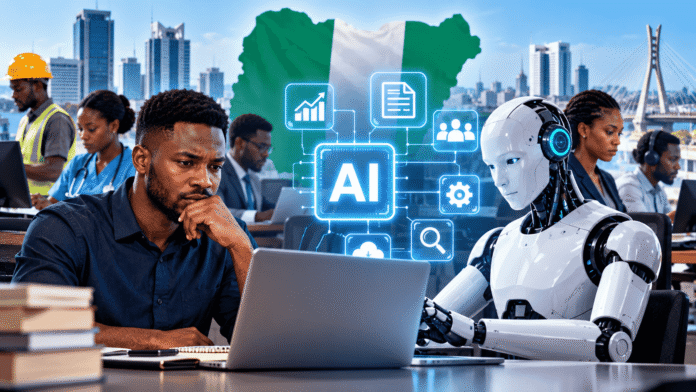
Artificial intelligence is no longer a distant technological concept for Nigeria’s workforce. It is already changing how businesses recruit, serve customers, conduct research, analyse information and get work done.
From banks and consulting firms to law offices, media organisations and recruitment companies, Nigerian employers are increasingly turning to AI to perform tasks that previously required significant human effort.
The shift is creating a difficult question for the country’s workforce: will AI create more opportunities for Nigerians, or eliminate jobs faster than new ones can emerge?
Recent findings suggest that both outcomes are possible.
Business leaders interviewed on the changing Nigerian labour market said AI is reducing reliance on some traditional roles while increasing productivity and creating demand for new digital skills. Research, clerical work and some administrative functions are among areas already being affected.
In the legal sector, for instance, AI tools can dramatically reduce the time required for research. In consulting, professionals can use AI to gather, organise and analyse information that previously required larger teams. Banks are also deploying AI for customer service, fraud detection, risk assessment and data analysis.
This does not necessarily mean that the jobs themselves will disappear overnight.
Instead, the nature of many jobs is changing.
A worker who once spent hours preparing reports may now use AI to produce a first draft in minutes. A customer-service employee may increasingly handle complex cases while AI deals with routine enquiries. A journalist, lawyer, accountant or researcher can use AI to accelerate information gathering but still needs human judgement to verify the result.
That distinction could become increasingly important in Nigeria.
The skills problem
Nigeria’s bigger challenge may be whether its workforce can adapt quickly enough.
Experts at the BusinessDay Talent Management Conference 2026 warned that the country’s workforce is not yet sufficiently prepared for an AI-driven economy. They identified gaps in practical skills, AI literacy, communication, critical thinking and the ability to integrate AI into actual workplace processes.
The problem extends beyond technology professionals.
AI is increasingly becoming a workplace tool rather than something reserved for programmers. A banker, teacher, marketer, entrepreneur, civil servant or accountant may not need to become an AI engineer, but understanding how to use AI effectively could increasingly determine productivity and employability.
Nigeria is already seeing efforts to close this gap.
In September, the Federal Government launched the Digital Training Academy, targeting 32,000 Nigerians with training in areas including artificial intelligence and machine learning, software development, cybersecurity, cloud computing and automation.
But training numbers alone will not solve the problem.
The more important question is whether workers are learning skills that employers actually need.
AI could create jobs too
There is another side to the debate.
As AI reduces demand for some routine functions, it is also creating demand for people who can build, manage, supervise and apply the technology.
Cybersecurity, data science, AI operations, compliance technology and other digital roles are already attracting greater attention from employers.
A PwC analysis of AI and jobs in Nigeria also suggests that AI can complement rather than simply replace human workers, with Nigerian employees reporting expectations of improved efficiency, creativity and work quality through generative AI.
This means the biggest threat may not be AI itself.
It may be the inability to adapt to it.
For a country with a large young population and a persistent need for quality employment, that distinction matters.
Nigeria cannot afford to approach AI merely as a technology trend. It is increasingly becoming a labour-market issue, an education issue and an economic-policy issue.
If the country gets the transition right, AI could allow Nigerian workers and businesses to compete for opportunities beyond the domestic market.
If it gets it wrong, automation could deepen existing employment and skills inequalities.
The race, therefore, is no longer about whether AI will enter Nigeria’s workplace.
It already has. The race is about whether Nigerian workers will be ready for what comes next.