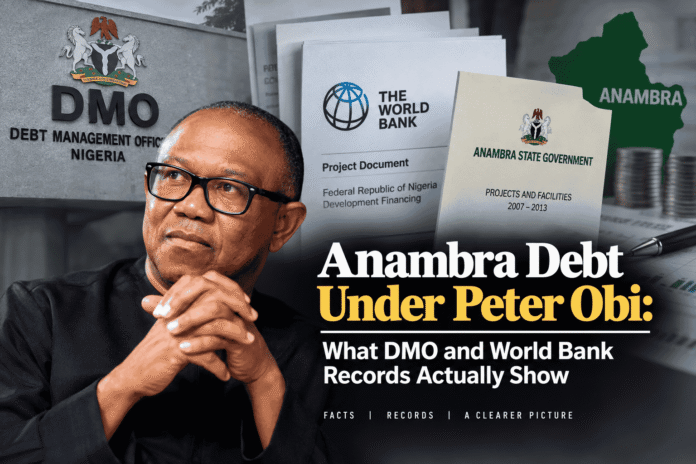
The renewed debate over the financial legacy of former Anambra State Governor Peter Obi has produced competing claims about whether his administration borrowed money and how much debt was left behind.
A review of records from Nigeria’s Debt Management Office (DMO) alongside World Bank project documents shows that the issue requires more than simply adding up every development project implemented in Anambra between 2006 and 2014.
There is clear evidence that Anambra had external debt during Obi’s administration and that the state was servicing external debt during the period.
However, the financing structure of several projects now being described as “Obi’s loans” was more complicated. In a number of cases, the Federal Republic of Nigeria was the original borrower, while Anambra was a participating state receiving funds through subsidiary financing arrangements.
That distinction is important.
What DMO Records Show
The DMO’s records show that Anambra had external debt throughout the Obi years.
DMO’s 2010 Annual Report records external-debt service deductions for Anambra of:
2006 — $5.53 million
2007 — $4.29 million
2008 — $4.00 million
2009 — $3.23 million
2010 — $0.77 million
These figures demonstrate that Anambra had external-debt obligations being serviced during Obi’s tenure.
By December 31, 2013, the DMO recorded Anambra’s external debt at $30,323,574.40.
Importantly, the DMO classified the entire amount as multilateral debt. It recorded no Anambra debt under AFD, China Exim Bank, commercial or Eurobond categories at that date.
The state’s domestic debt at the same date was ₦3,025,797,046.67, according to the DMO’s revised 2013 domestic-debt table.
Peter Obi remained governor until March 17, 2014, meaning the December 2013 figures were recorded only about three months before his departure.
What About the $123.74 Million Now Being Attributed to Obi?
The Anambra State Government has released a breakdown identifying eight external facilities signed between 2007 and 2013, with a combined original value of approximately $123.74 million based on the individual figures listed.
The facilities cited are:
1. Malaria Control Booster Project
Date: May 2007
Amount: $9.46 million
2. Third National Fadama Development Project
Date: August 2009
Amount: $7.17 million
3. Health System Development Project II
Date: August 2009
Amount: $4.12 million
4. Community and Social Development Project
Date: March 2009
Amount: $4.84 million
5. Malaria Control Booster Project — Additional Financing
Date: December 2009
Amount: $4.43 million
6. State Education Programme Investment Project (SEPIP)
Date: July 2013
Amount: $48.33 million
7. Nigeria Erosion and Watershed Management Project (NEWMAP)
Date: July 2013
Amount: $37.89 million
8. Value Chain Development Project
Date: July 2013
Amount: $7.50 million
Total: $123.74 million
However, this figure requires an important qualification.
The $123.74 million represents the original facility amounts cited by the Anambra State Government. It should not automatically be interpreted as the amount actually disbursed to Anambra, the amount borrowed directly by the state, or the amount outstanding when Obi left office.
Those are separate financial measurements.
The Borrower Was Not Always Anambra State
Take the State Education Programme Investment Project (SEPIP) as an example.
World Bank documentation describes SEPIP as a credit to the Federal Government of Nigeria, with participating states receiving funds through subsidiary financing arrangements.
Therefore, it would be misleading to describe the entire national facility as a loan personally obtained by Peter Obi.
The same principle applies to other World Bank-supported national programmes in which Anambra participated.
This does not necessarily mean Anambra had no repayment obligation.
Where the Federal Government on-lent the relevant portion to a state under a subsidiary agreement, the state could have a liability even though the original international loan agreement named the Federal Government as borrower.
The distinction is therefore between:
Original international borrower
and
State-level beneficiary or sub-borrower and its repayment obligation.
Those are not necessarily the same thing.
What DMO Actually Proves
The DMO evidence is significant because it does not depend on today’s political statements.
It independently records Anambra’s external debt position.
By December 2013, Anambra had $30.32 million in outstanding external debt, while its domestic debt stood at approximately ₦3.03 billion.
This makes an absolute statement that Anambra had zero public debt around the end of Obi’s tenure difficult to reconcile with the DMO’s published debt-stock records.
At the same time, the DMO records do not establish that Peter Obi personally borrowed $123.74 million.
The DMO debt-stock table is a record of outstanding debt. It is not a transaction-by-transaction register identifying which governor signed each individual facility, how much was disbursed during a particular governor’s tenure, or how much remained outstanding on the exact day of handover.
What Happened to Anambra’s External Debt?
The DMO records show that Anambra’s external debt remained on the state’s books during the Obi administration.
The DMO also recorded substantial external-debt service payments during the early years of his administration.
This means the picture is not one of an administration with no external debt whatsoever.
However, neither does the available DMO evidence establish that every dollar of the debt stock at the end of 2013 was newly borrowed by Obi.
Some liabilities could have originated from earlier facilities, while others could have arisen through disbursements under Federal Government-negotiated programmes.
That is why a simple before-and-after comparison must be handled carefully.
The December 2005 Figure Also Needs Context
Some discussions have used Anambra’s $68.53 million external debt recorded at the end of 2005 as the amount Peter Obi inherited.
That requires caution.
Obi assumed office in March 2006, rather than at the beginning of 2005, and the December 2005 figure came during the period surrounding Nigeria’s historic Paris Club debt-relief arrangements.
For that reason, the December 2005 figure should not simply be presented as Obi’s exact inherited debt on the day he assumed office.
The more appropriate approach is to examine the DMO debt position around the beginning of his administration and compare it with the position immediately before he left.
The available DMO records show Anambra’s external debt at approximately $16.87 million at December 31, 2006, while it stood at $30.32 million at December 31, 2013.
This means the state’s recorded external debt stock was higher at the end of the period than in 2006.
However, this change alone does not establish how much was newly borrowed by Obi’s administration because debt stocks can change through disbursements under existing facilities, repayments, exchange-rate movements and other adjustments.
Domestic Debt: Another Part of the Picture
Anambra’s domestic debt also existed during the later years of Obi’s administration.
DMO records put the state’s domestic debt at:
₦6.40 billion in December 2011
₦14.30 billion in December 2012
₦3.03 billion in December 2013
The sharp fall between 2012 and 2013 is noteworthy.
Therefore, while Anambra undeniably had domestic debt during the period, the DMO record also shows that its recorded domestic debt position had fallen substantially by the end of 2013.
So, Did Peter Obi Borrow Money?
Based strictly on the records examined, the safest conclusion is: YES
Anambra incurred and carried external and domestic debt during Peter Obi’s administration, and external development-financing facilities associated with projects in the state were signed during his tenure.
However, the available DMO and World Bank records do not justify reducing the entire $123.74 million to the statement that:
“Peter Obi personally borrowed $123.74 million.”
The financing arrangements were more complicated.
Several World Bank programmes were structured as Federal Government borrowings with participating states receiving funds through subsidiary financing arrangements.
Consequently, the proper questions are not simply:
“Did Obi borrow $123.74 million?”
The more precise questions are:
How much of each facility was actually disbursed to Anambra?
How much was disbursed before Obi left office?
What portion constituted a direct state repayment obligation?
How much remained outstanding on March 17, 2014?
And finally:
How much of the debt still being serviced today originated from those facilities?
Those questions require examining the individual subsidiary financing agreements and DMO debt records rather than simply adding the original facility values.
The Bottom Line
The records do not support the claim that Anambra was completely debt-free during or immediately before the end of Peter Obi’s administration.
The DMO recorded $30.32 million in external debt and ₦3.03 billion in domestic debt as of December 31, 2013, less than three months before Obi left office.
At the same time, the evidence does not support simply describing the entire $123.74 million in eight development facilities as money Peter Obi personally borrowed from international lenders.
The financing structure matters.
The difference between a Federal Government loan, a state-level subsidiary obligation, the amount approved, the amount actually disbursed and the amount outstanding could be substantial.
Therefore, the DMO and World Bank records present a more nuanced picture than either side of the political argument.
Anambra had documented debt during Peter Obi’s tenure. But determining precisely how much Obi’s administration borrowed requires tracing each facility from approval to disbursement, state-level obligation and outstanding balance — rather than treating the original value of every project facility as money borrowed directly by the former governor.