
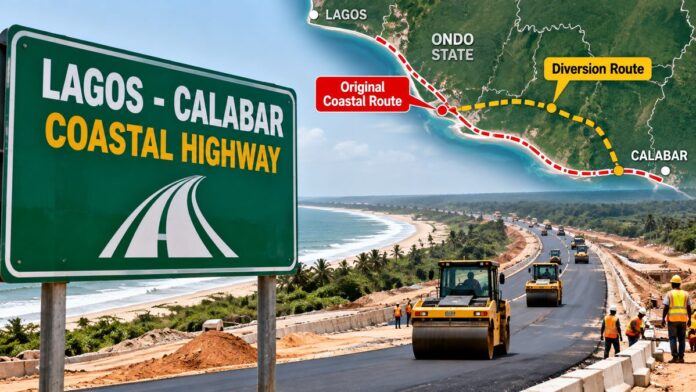
A fresh controversy has erupted over the Lagos-Calabar Coastal Highway following allegations that the Federal Government has diverted the proposed Ondo State section of the project away from the Ilaje coastline to an inland route.
The development has prompted Ilaje Omuro Community Connect (IOCC), a community-based organisation representing more than 1,000 members of Ilaje extraction, to petition President Bola Tinubu, the National Assembly and relevant anti-corruption agencies over the reported realignment.
In its petition, the organisation demanded an independent engineering assessment, a comparative audit of construction costs and the public release of documents explaining the decision to alter the proposed route.
The group argued that the reported change raises concerns about economic inclusion, regional development, environmental protection and the equitable distribution of the benefits of major federal infrastructure projects.
The Lagos-Calabar Coastal Highway, one of the flagship infrastructure projects of the Tinubu administration, is designed to cover approximately 750 kilometres, connecting Lagos with Calabar, Cross River State.
However, the proposed route through the Ilaje coastal axis of Ondo State has become the subject of disagreement between community representatives and the Federal Ministry of Works.
Umahi Defends Route Realignment
Minister of Works, David Umahi, has defended the reported route alteration, insisting that the decision was informed by engineering considerations and the need to ensure value for public funds.
Umahi reportedly explained that sections of the original proposed alignment contained pits exceeding 100 metres in depth, with limited availability of suitable sharp sand within a 300-metre radius.
According to the minister, the terrain would require extensive filling and ground stabilisation, potentially making construction along the original alignment technically challenging and significantly more expensive.
He maintained that the government had considered the engineering implications before settling on the alternative route.
The minister also indicated that he was aware of petitions challenging the decision but remained confident in the justification for the realignment.
However, the explanation has failed to convince the Ilaje organisation, which insists that the government must provide verifiable technical evidence to justify moving the highway away from the proposed coastal corridor.
Ilaje Group Questions Engineering Claims
In its response, IOCC challenged the suggestion that the terrain along the Ilaje coastline was unsuitable for major road construction.
The organisation cited previous road projects undertaken in the area, including the Igbokoda-Ugbonla road project associated with the Ondo State Oil Producing Areas Development Commission (OSOPADEC).
It also referenced a reported contract awarded by the Niger Delta Development Commission (NDDC) in 2010 for the Ugbonla-Awoye axis.
According to the group, these projects warrant a more detailed explanation of the specific geological, environmental and engineering obstacles that allegedly make the proposed coastal highway alignment impracticable.
It called on the Federal Ministry of Works to publish the feasibility studies, geotechnical investigations, environmental impact assessments and comparative cost analyses used in reaching the decision.
The organisation also requested an independent assessment by qualified engineering professionals to determine whether the alternative alignment offers better value for public money.
However, the existence of previous road projects in the area does not, on its own, establish that the entire proposed highway corridor is technically or economically viable. A comprehensive comparative assessment would be necessary to settle the disagreement.
Concerns Over Economic Opportunities and Coastal Communities
Beyond the engineering dispute, the alleged diversion has raised concerns about the potential economic consequences for communities along Ondo State’s coastline.
Ilaje communities have long faced challenges associated with coastal erosion, sea incursion, inadequate transport infrastructure and limited access to economic opportunities.
The organisation warned that excluding the proposed Ilaje corridor could constrain opportunities in fisheries, agriculture, tourism, trade and logistics by limiting connectivity and discouraging investment.
It also argued that a major national highway should be planned in a manner that considers the development needs of communities along its intended corridor.
For the group, the controversy extends beyond the location of a road. It concerns whether communities in coastal areas will have a fair opportunity to benefit from a major infrastructure investment financed with public funds.
Nevertheless, the extent to which the highway could address these challenges would depend on its final alignment, engineering design and environmental protection measures.
Calls for Tinubu’s Intervention
IOCC has called on President Tinubu to intervene and ensure that the decision is subjected to transparent and independent scrutiny.
The organisation also urged the National Assembly to exercise its oversight responsibilities and requested that relevant anti-corruption agencies examine any credible evidence of financial misconduct or abuse of office connected with the route alteration.
It further demanded a comparative assessment of the original proposed alignment and the alternative route, including construction costs, environmental implications, long-term economic benefits and overall value for money.
The group maintained that the government should consult affected communities and relevant stakeholders before finalising a decision with far-reaching consequences for the region.
The controversy follows earlier objections by Ilaje and Itsekiri stakeholders, who reportedly resolved at a meeting in Lagos on September 19, 2026, to work together to ensure that the highway retains its proposed coastal alignment.
Some stakeholders have also threatened legal action over the reported realignment.
Transparency Remains the Central Issue
The dispute presents the Federal Government with an opportunity to demonstrate transparency in the execution of one of its most ambitious infrastructure projects.
While engineering challenges, environmental conditions and construction costs are legitimate considerations in highway planning, decisions involving public infrastructure should be supported by evidence that can withstand independent scrutiny.
Equally, allegations of wrongdoing should not be treated as established facts without supporting evidence.
The Federal Ministry of Works can help resolve the controversy by publishing the relevant technical assessments and explaining why the alternative route was considered preferable to the proposed Ilaje alignment.
An independent review would also help establish whether the realignment provides the best balance between construction costs, engineering feasibility, environmental sustainability and regional economic benefits.
As the disagreement intensifies, the priority should be to ensure that the final decision is guided by verifiable evidence, sound engineering and the public interest.
For the Ilaje communities, the demand is clear: the Federal Government must explain the decision and demonstrate that the route selected for the Lagos-Calabar Coastal Highway represents the most defensible use of public resources.
