
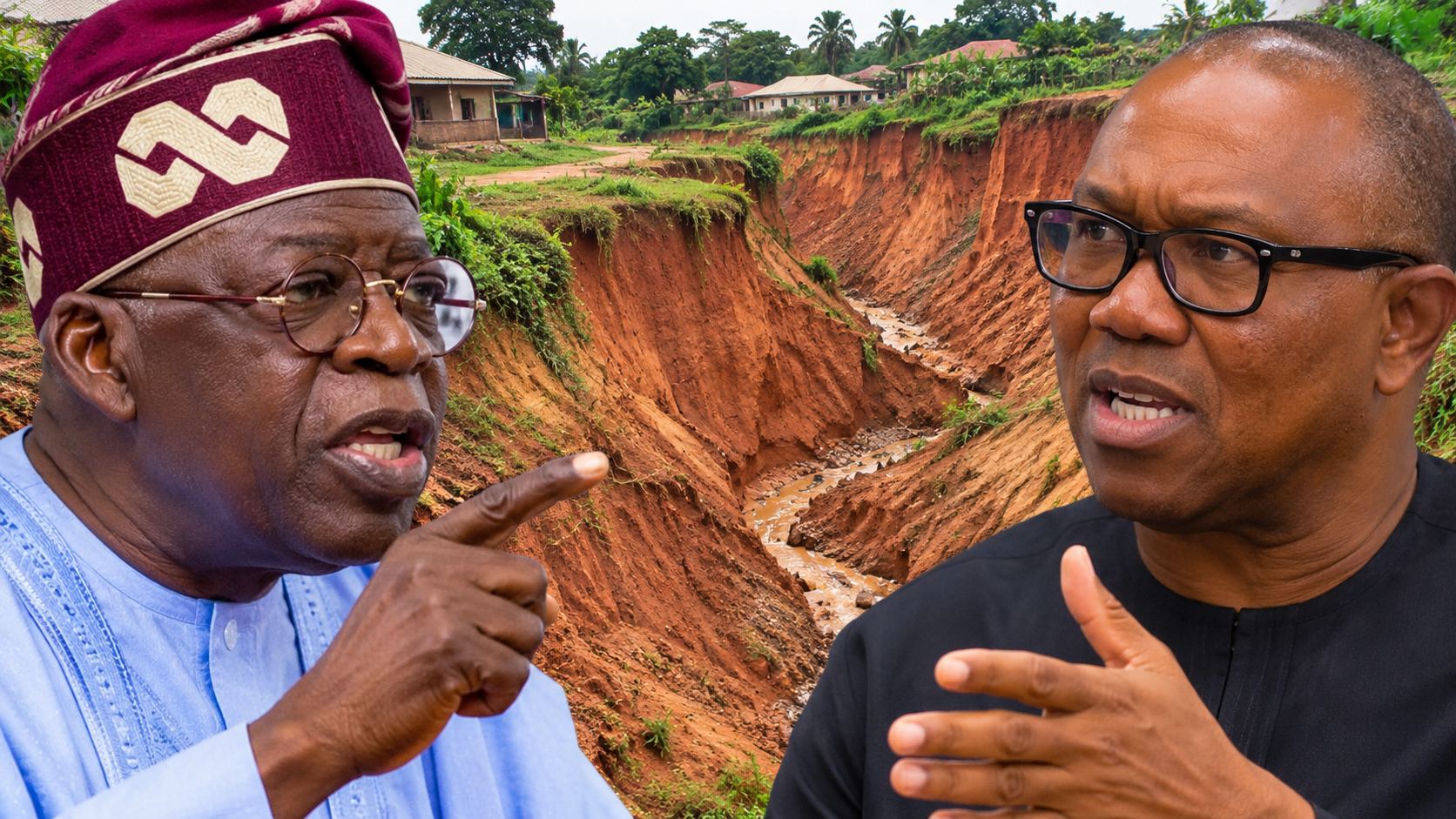
Did Peter Obi Really Run Away From Erosion? Examining Tinubu’s Claims Against The Facts
President Bola Ahmed Tinubu’s attempt to ridicule Peter Obi over the devastating gully erosion problem in Anambra State has raised an important question about political accountability: Did the former Anambra governor actually abandon the fight against erosion, or is the President presenting a complicated environmental challenge as evidence of leadership failure?
Speaking at the All Progressives Congress rally in Uyo, Akwa Ibom State, on Friday, November 6, 2026, Tinubu accused Obi of running away from erosion in Anambra, contrasting his record with what he described as his own success in confronting the Atlantic Ocean in Lagos.
“He ran away from erosion in Anambra State. He could not confront erosion. I, Bola Ahmed Tinubu, confronted the Atlantic Ocean,” the President declared.
It was a politically convenient attack, particularly at a time when opposition figures are positioning themselves against his re-election bid.
But political mockery does not replace historical evidence. And when the records are examined, Tinubu’s suggestion that Obi simply ran away from the erosion crisis becomes considerably more difficult to sustain.
OBI DID NOT IGNORE THE EROSION CRISIS
Anambra State has one of Nigeria’s most severe gully erosion problems. The crisis predates Peter Obi’s administration and has continued beyond his departure from office.
Communities have lost homes, roads, farmlands and valuable properties to expanding gullies. In some locations, entire stretches of land have been swallowed by erosion.
There is, however, a difference between failing to eliminate a problem and refusing to confront it.
Available historical records show that Obi’s administration took identifiable steps to address the crisis.
In December 2012, for instance, Obi personally inspected the Isulo erosion site, where the expanding gully threatened to cut off the Akpu–Ajalli–Isulo–Umunze road.
During the inspection, he identified poor road construction practices and inadequate drainage systems as contributing factors.
His administration also pursued a policy requiring proper engineering designs and drainage infrastructure for road construction.
These are not the actions of a governor who simply disappeared from a problem.
They may not have been sufficient to eliminate the crisis, but they contradict the suggestion that he refused to confront it.
THE NEWMAP INITIATIVE: A RECORD TINUBU’S ATTACK OVERLOOKS
Perhaps the most significant evidence against Tinubu’s allegation is Obi’s involvement in the Nigeria Erosion and Watershed Management Project (NEWMAP), a major intervention designed to address erosion across several Nigerian states.
Former Minister of Environment, John Odey, publicly acknowledged in September 2014 that Obi was instrumental to the creation of the initiative.
According to Odey, Obi almost single-handedly pushed for the project when some of his fellow governors were initially reluctant.
More importantly, the World Bank Country Director at the time, Marie-Françoise Marie-Nelly, praised Obi’s commitment, disclosing that Anambra was the first state to pay its N500 million counterpart contribution.
The initiative was designed to bring together federal and state governments, the World Bank and affected communities to tackle erosion through engineering interventions and watershed management.
The Anambra NEWMAP programme was formally launched in June 2014, shortly after Obi left office in March. Nevertheless, the historical record establishes his administration’s involvement in advancing the initiative and providing counterpart funding.
That is hardly the record of someone who simply ran away from erosion.
BUT DID OBI SOLVE THE EROSION PROBLEM?
This is where the conversation requires honesty.
No serious assessment should suggest that Peter Obi completely conquered Anambra’s erosion problem.
The crisis remained significant after his administration. Several communities continued to suffer devastating environmental damage, while some intervention projects experienced delays and implementation challenges.
A December 2021 investigation by Radio Nigeria, for instance, documented poor-quality work, neglect and delays at several erosion intervention sites in Anambra, despite billions of naira having been committed to projects.
This demonstrates that the problem was far from resolved.
However, it also reinforces the need to distinguish between initiating interventions, implementing projects and achieving complete environmental rehabilitation.
Obi deserves scrutiny over what his administration achieved and what remained unfinished. But claiming that he ran away from erosion requires evidence of abandonment, not merely evidence that the problem persisted.
WHAT ABOUT TINUBU’S CLAIM OF CONFRONTING THE ATLANTIC OCEAN?
The President’s comparison also deserves examination.
Tinubu’s reference to confronting the Atlantic Ocean appears to centre on the coastal protection and reclamation initiatives associated with Eko Atlantic and the Great Wall of Lagos.
There is a legitimate historical record of the Lagos State Government’s involvement in coastal protection during his governorship.
In 2005, following severe storm damage around Bar Beach, the Lagos State Government awarded a contract for shoreline protection. A two-kilometre sea wall was completed in December 2006, before Tinubu left office in May 2007.
However, the larger Eko Atlantic development and construction of its Great Wall began in 2008, after Tinubu had left office.
The project is also a public-private partnership involving private investors and the Lagos State Government.
Therefore, while Tinubu can legitimately claim a role in initiating coastal protection efforts in Lagos, presenting the entire Eko Atlantic development as his personal accomplishment oversimplifies its history and financing.
THE DOUBLE STANDARD IN JUDGING GOVERNMENT PERFORMANCE
There is another important question here.
If Tinubu believes that the persistence of erosion in Anambra proves Obi’s failure, should Nigerians apply the same standard to every environmental challenge that remains unresolved under his own administration?
Should the continued flooding of communities across Nigeria automatically mean that the President has run away from flooding?
Should the persistence of insecurity automatically mean that he has refused to confront insecurity?
Of course, the answer is no.
Governments must be judged by their policies, interventions, implementation records and measurable outcomes.
The same standard must apply to Peter Obi, Bola Tinubu and every other political officeholder.
It is also worth remembering that Tinubu’s eight years as Lagos governor and Obi’s eight years as Anambra governor involved different geographical realities, environmental challenges and available resources.
A fair comparison must examine what each administration inherited, what it invested, what it achieved and what it left unresolved.
THE VERDICT: TINUBU’S CLAIM DOES NOT STAND UP TO THE AVAILABLE EVIDENCE
Based on the historical records examined, there is evidence that Peter Obi’s administration confronted Anambra’s erosion crisis through site inspections, drainage policies, engagement with the Federal Government and participation in the NEWMAP initiative.
There is equally evidence that the problem remained unresolved in several communities.
What is missing, however, is credible evidence to establish that Obi abandoned the challenge or simply ran away from it.
Tinubu’s allegation therefore confuses an incomplete outcome with an absence of effort.
That distinction matters.
The President is entitled to question Obi’s performance as governor. He is entitled to ask why erosion remained a major challenge in Anambra after eight years of his administration.
But if he chooses to make such accusations, Nigerians are equally entitled to demand evidence and examine his own record.
Political campaigns should be opportunities for candidates to demonstrate their achievements and explain their shortcomings, not occasions to rewrite history for applause.
If Obi’s erosion record deserves scrutiny, so does Tinubu’s coastal protection record. If Obi must account for unfinished projects, Tinubu must also account for the promises and projects that remain unfulfilled under his presidency.
Ultimately, Nigeria needs leaders who can defend their records with facts, not leaders who believe that ridiculing political opponents is an adequate substitute for explaining their own performance.
The question is not whether Peter Obi eliminated every gully in Anambra. He did not. The question is whether he ran away from the challenge. Available documentary evidence says otherwise.
EDITOR’S NOTE: This is an independent political analysis based on available historical reports and documentary records. It does not represent an endorsement of any political party or candidate.