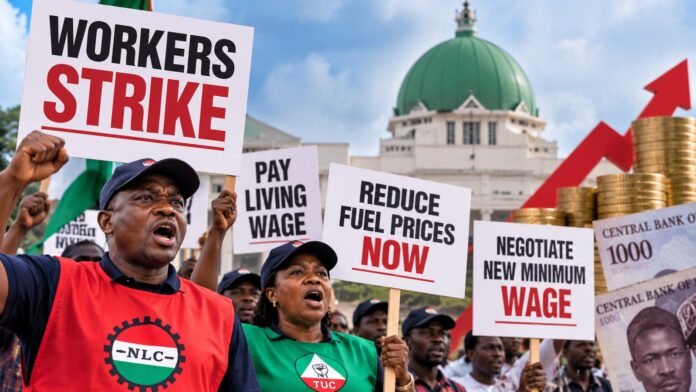
Workers under the Joint National Public Service Negotiating Council (JNPSNC) embarked on the October 2–4 warning strike after the Federal Government failed to address demands including a reduction in petrol prices, a wage award and the commencement of negotiations for a new national minimum wage ahead of 2027.
The development should not be treated as another routine confrontation between government and organised labour.
At the heart of the dispute is the purchasing power of Nigerian workers.
The current national minimum wage of ₦70,000 was introduced amid an economy in which the cost of transportation, food, housing and other necessities has continued to place pressure on household incomes. The unions have argued that the present situation requires additional measures to protect workers from the effects of rising living costs.
Their demand for a wage award and an early process for negotiating a new minimum wage therefore deserves serious consideration.
At the same time, industrial action comes with consequences that extend beyond government offices.
When public servants withdraw their services, ordinary Nigerians are often the first to feel the impact. Administrative services slow down, government offices become inaccessible and citizens who depend on public institutions for essential services bear the burden.
That is why both sides have a responsibility to prevent another shutdown.
Government must recognise that workers cannot be expected to absorb indefinitely the rising cost of living without a meaningful response. Labour unions, on the other hand, must ensure that industrial action remains a last resort and that negotiations remain central to resolving disputes.
The latest warning from the JNPSNC that public-sector workers could embark on a more extensive shutdown if their concerns remain unresolved should therefore be treated as a signal for renewed engagement, not another opportunity for confrontation.
The Federal Government should return to the negotiating table with organised labour and establish a clear, transparent timeline for addressing the outstanding issues.
There is also a need for greater clarity on the government’s broader wage and economic policies. Workers need to know what measures are being considered, when they will take effect and how they will protect incomes as the country adjusts to ongoing economic reforms.
For labour, the objective should equally go beyond shutting down the system. The ultimate purpose of industrial action should be to secure sustainable improvements in workers’ welfare.
Nigeria cannot afford a cycle in which workers issue ultimatums, government waits until a strike begins, negotiations resume under pressure, and the same grievances return months later.
The government should act before another strike becomes necessary. Dialogue is cheaper for the country than disruption, and a negotiated settlement is preferable to another shutdown of public services.