
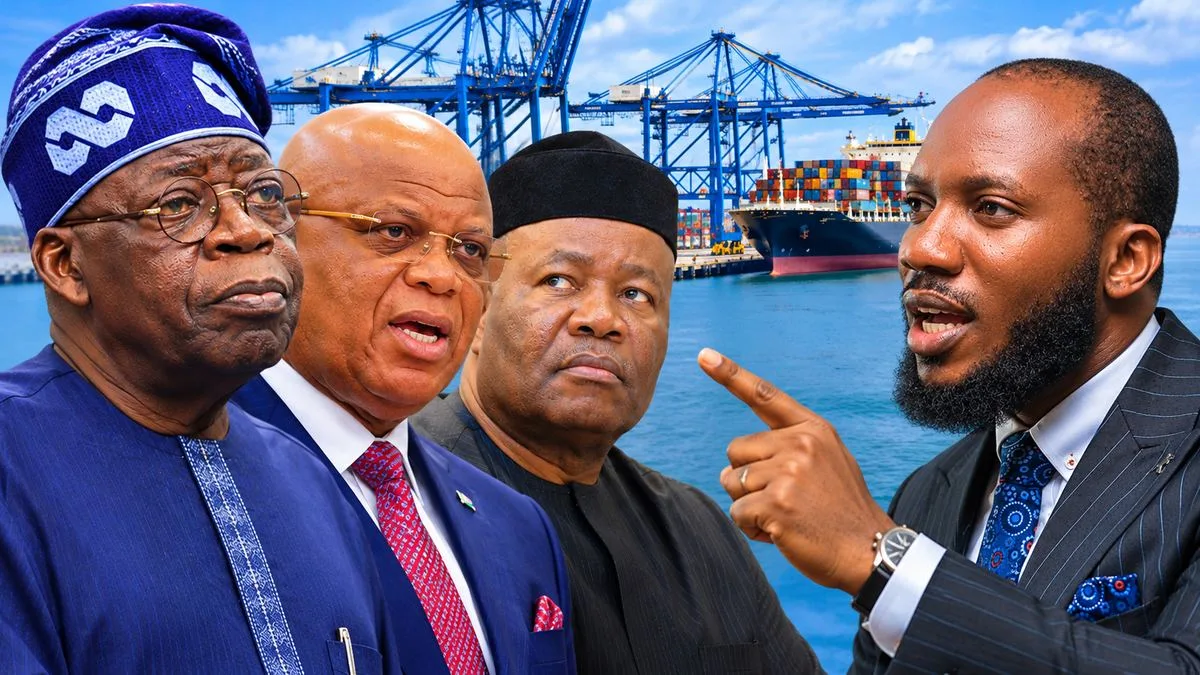
Ibom Deep Seaport: Inibehe Effiong Slams Tinubu, Umo Eno Over Approval, Condemns Forced Attendance At Campaign Rally
Human rights lawyer, Inibehe Effiong, has criticised President Bola Tinubu and Akwa Ibom State Governor, Umo Eno, over the renewed announcement of approval for the proposed Ibom Deep Seaport, describing the development as another episode of political deceit.
Effiong, in a statement issued following Tinubu’s visit to Akwa Ibom State on Friday, November 6, 2026, also condemned what he described as the forced mobilisation of residents and civil servants to attend the president’s campaign event.
Tinubu, who visited the state as part of activities surrounding his re-election campaign, announced that he had approved the establishment of the proposed Ibom Deep Seaport, raising fresh expectations about the long-awaited maritime project.
However, Effiong questioned the credibility of the announcement, arguing that successive administrations in the state had repeatedly made similar promises without delivering the project.
According to the lawyer, former governors Godswill Akpabio and Udom Emmanuel, as well as the incumbent governor, Umo Eno, had all made claims about approvals for the same seaport during their respective administrations.
He recalled that former President Goodluck Jonathan had reportedly approved the project during Akpabio’s administration, while the administration of former President Muhammadu Buhari also gave approval during Udom Emmanuel’s tenure.
Effiong argued that Tinubu’s latest announcement represented another repetition of promises that had failed to translate into a functional seaport.
He further alleged that successive state governments had appropriated and wasted public resources in the name of the project, describing the recurring announcements as a means of misleading the people of Akwa Ibom.
The lawyer insisted that residents deserved tangible progress rather than recurring political announcements.
EFFIONG FAULTS ENO OVER WORK-FREE DAY
Beyond the seaport controversy, Effiong condemned Governor Eno’s decision to declare Friday a work-free day ahead of Tinubu’s visit, arguing that the move amounted to an abuse of public office.
He maintained that the governor had no constitutional justification for shutting down public activities to accommodate what he described as a partisan political gathering.
The lawyer accused Eno of blurring the distinction between official state functions and activities organised to advance the political interests of the All Progressives Congress (APC).
He questioned whether the governor would extend similar privileges to presidential candidates of opposition parties by declaring work-free days and directing civil servants to attend their campaign rallies.
Effiong also expressed concern over the reported accident involving a vehicle conveying women to the airport to welcome Tinubu, which allegedly resulted in a fatality.
He described the incident as particularly troubling and questioned the circumstances surrounding the mobilisation of residents for the presidential visit.
SEAPORT APPROVAL AND THE POLITICAL QUESTION
Tinubu’s latest announcement has revived public discussion about the long-awaited maritime project, which has featured prominently in Akwa Ibom’s political promises across successive administrations.
Notably, Tinubu had also pledged to support the establishment of the deep seaport during his 2023 presidential campaign rally in Uyo.
On Friday, November 6, 2026, he renewed the promise after Governor Eno reportedly requested federal approval for the project at the APC rally.
The governor had also pledged that Akwa Ibom would deliver two million votes for Tinubu’s re-election in 2027 if the Federal Government facilitated the delivery of the seaport.
While the latest announcement has been presented as a significant development for the state, questions remain about the practical steps required to translate the approval into an operational maritime facility.
For a project with enormous economic potential, residents will expect more than presidential declarations. They will want to see documented approvals, clear financing arrangements, construction timelines and evidence of actual implementation.
Effiong insists that the people of Akwa Ibom must no longer accept what he considers a recurring cycle of political promises without corresponding results.
He concluded by describing Akwa Ibom residents as free citizens who must not be subjected to the political interests of individuals in power, while also condemning the Tinubu administration’s economic policies and their impact on Nigerians.
The proposed Ibom Deep Seaport remains a major economic aspiration for Akwa Ibom State, with its eventual realisation expected to depend on concrete federal action, funding and implementation rather than political announcements alone.