
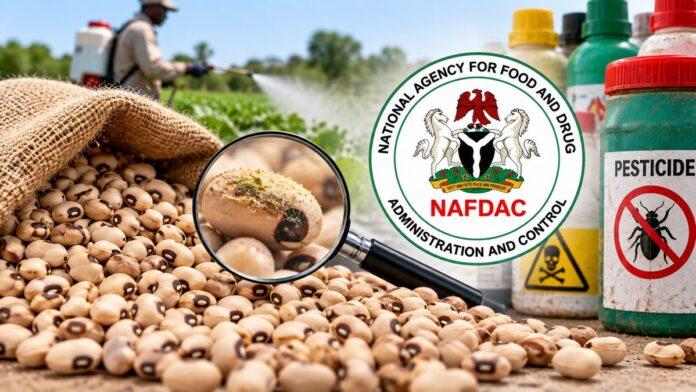
The National Agency for Food and Drug Administration and Control (NAFDAC) has raised the alarm over the detection of pesticide residues above permissible limits in some samples of beans sold in Nigerian markets.
The agency warned that the misuse of agricultural chemicals, particularly their improper application and use for purposes for which they are not approved, could undermine food safety and expose consumers to potentially harmful chemical residues.
The Director-General of NAFDAC, Professor Mojisola Adeyeye, disclosed the findings during a press briefing in Lagos, explaining that a recent market study detected pyrethroids and dimethoate at levels exceeding permitted limits in some bean samples.
According to reports published on Monday, October 12, the agency has also reiterated its ban on pesticides containing paraquat, chlorpyrifos and atrazine, while intensifying efforts to prevent prohibited chemicals from circulating in the country.
The findings have renewed concerns about the safety of agricultural produce and the need for stricter monitoring of pesticide use, particularly in a country where beans remain an important and affordable source of dietary protein.
NAFDAC Warns Against Improper Pesticide Use
Adeyeye cautioned farmers and other agricultural produce handlers against the assumption that applying larger quantities of pesticides would produce better results.
She explained that approved pesticides must be applied according to established safety standards, including recommended quantities and the required waiting period between application and harvest.
The NAFDAC chief also warned against the use of dimethoate to preserve harvested beans against weevil infestation.
Although dimethoate may be permitted for certain applications in the field, she said it is not approved for preserving harvested beans against weevils.
The distinction is important because a chemical’s approval for a particular agricultural use does not automatically make it safe for every other application.
NAFDAC therefore urged farmers to follow product instructions and avoid applying chemicals to crops or for purposes outside their approved uses.
What Consumers Should Know About the Findings
The detection of excessive pesticide residues in some bean samples raises legitimate food safety concerns. However, the finding does not establish that all beans sold in Nigerian markets are contaminated.
NAFDAC’s reported disclosure did not provide the number of samples tested, their precise collection locations or the measured concentrations of the detected chemicals.
Those details would help consumers and public health professionals better understand the scale of the problem and assess the extent of the potential risk.
Nevertheless, the findings underline the importance of effective pesticide regulation, regular food testing and responsible chemical use throughout the agricultural supply chain.
Consumers should also be cautious about claims that ordinary washing or cooking will necessarily eliminate pesticide residues. Such methods cannot be assumed to remove every chemical under all circumstances.
The priority, therefore, should be preventing unsafe pesticide application and ensuring that agricultural produce meets established safety requirements before reaching consumers.
NAFDAC Reaffirms Ban on Three Pesticides
Beyond the findings on beans, NAFDAC has reiterated that the applicable phase-out periods for banned pesticide products containing paraquat, chlorpyrifos and atrazine ended on January 1, 2026.
According to the agency, products containing the prohibited active ingredients can no longer legally be manufactured, imported, distributed, sold or used in Nigeria.
However, the regulator said surveillance and enforcement operations continue to uncover prohibited products in circulation.
NAFDAC attributed the continued availability of such chemicals to illegal importation, unauthorised local production and distribution through informal channels.
The agency said it was strengthening cooperation with relevant government institutions and law enforcement authorities to improve market surveillance, identify illegal products and take action against those responsible for regulatory violations.
NAFDAC Intercepts Agrochemicals Worth Over ₦800 Million
In a related development, NAFDAC disclosed that it had intercepted prohibited agrochemicals valued at more than ₦800 million in Ogun, Ondo, Osun and Oyo states.
Separate enforcement operations in Kebbi and Kano states also uncovered additional consignments of banned pesticides and unauthorised agrochemical manufacturing facilities.
The agency warned that improper pesticide use could expose people to serious health risks, including neurological complications, cancer and reproductive harm. The nature and likelihood of these risks depend on the chemical involved, the level and duration of exposure, and other factors.
NAFDAC has urged farmers and agrochemical users to purchase approved products from legitimate dealers, follow label instructions, use the recommended quantities and observe the required waiting periods before harvesting crops.
The regulator also encouraged exporters to take advantage of its interim free testing programme for products intended for export, aimed at helping them meet applicable safety requirements and reduce the risk of rejected consignments.
Food Safety Requires More Than Warnings
The latest findings raise questions about the effectiveness of food safety monitoring and the accessibility of reliable guidance for farmers who use agricultural chemicals.
While warnings and enforcement operations are necessary, protecting consumers also requires accessible laboratory testing, effective traceability systems and practical support to help farmers adopt safe pest-control and storage methods.
NAFDAC should make relevant testing information available, including the number of samples examined, the locations from which they were collected and the extent to which the detected residues exceeded applicable limits.
Such disclosure would help the public understand the findings without creating the impression that all beans sold in the country are unsafe.
Authorities must also ensure that enforcement efforts extend beyond farmers and market traders to the suppliers and distributors responsible for putting prohibited or improperly labelled chemicals into circulation.
For consumers, the central message is that food safety must begin long before produce reaches the market. Preventing the misuse of pesticides, enforcing existing regulations and improving monitoring remain essential to protecting public health.
Polity Nigeria will continue to follow developments concerning food safety and the regulation of agricultural chemicals in Nigeria.
