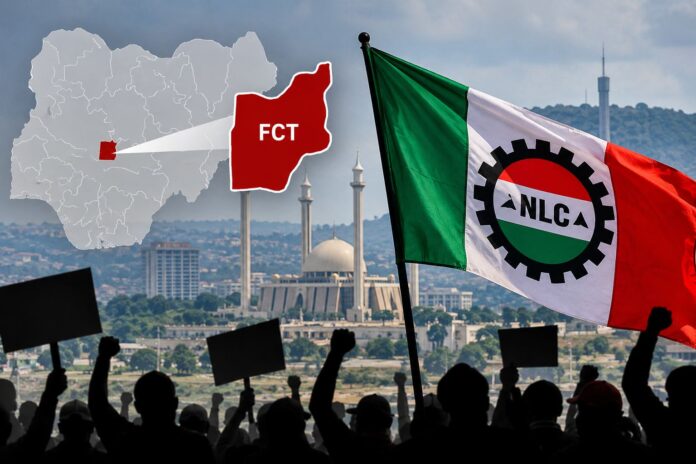
The Federal Capital Territory (FCT) Council of the Nigeria Labour Congress (NLC) has declared an indefinite strike across the nation’s capital following the failure to resolve a prolonged dispute over the promotion and welfare of teachers.
The industrial action commenced on Wednesday, October 7, after the expiration of a seven-day ultimatum issued by the labour body to the Federal Capital Territory Administration (FCTA).
The NLC directed workers across both the public and private sectors in the FCT to withdraw their services until its demands are addressed.
At the centre of the dispute is the FCTA’s policy requiring vacancies to exist before teachers can be promoted.
The NLC argues that the requirement has contributed to prolonged career stagnation among teachers, insisting that educators recruited specifically to teach should be promoted when due rather than having their progression tied to available vacancies.
The labour council is also demanding that teachers who became eligible for promotion in 2025 be allowed to take their promotion examinations alongside or ahead of the 2026 candidates.
Other demands include the withdrawal of redeployment and demotion letters issued to directors affected by the implementation of the Harmonised Retirement Age for Teachers Act, 2022.
The NLC is further calling for the dissolution and reinstatement of the management teams of the FCT Secondary Education Board (SEB) and the FCT Universal Basic Education Board (UBEB).
FCTA response rejected
The strike followed the NLC FCT Council’s rejection of the response from the FCTA to its ultimatum.
NLC FCT Chairman, Knabayi S. Adalo, said the administration’s response failed to address what the union considers the central issues in the dispute, particularly the vacancy requirement for teachers’ promotion.
The council subsequently directed its affiliate unions to mobilise workers and ensure compliance with the industrial action.
The NLC said the strike would be total and indefinite until its demands are resolved.
Education sector caught in the dispute
The industrial action has already affected schools in the territory, with the Federal Capital Territory chapter of the Nigeria Union of Teachers (NUT) directing teachers in primary and secondary schools to stay away from work.
However, the strike has also exposed differences among education stakeholders.
The FCT Universal Basic Education Board directed teachers to disregard the NLC’s strike directive and resume their duties, while the NUT maintained that teachers should comply with the industrial action.
The Academic Staff Union of Secondary Schools (ASUSS), FCT chapter, has also dissociated itself from the strike, directing secondary schools to remain open and teachers to continue with their normal duties.
The conflicting directives have created uncertainty for schools, teachers, parents and students across the territory.
What happens next?
The immediate focus is now on whether the FCTA and labour unions can return to negotiations and resolve the issues at the heart of the dispute.
For residents of Abuja, the continuation of the strike could affect the operation of government offices, schools, hospitals and other establishments if the NLC’s directive is fully enforced across the territory.
The NLC has maintained that it will not suspend the action until its demands are satisfactorily addressed, while some education authorities have continued to push for normal operations.
As the dispute enters a new phase, the outcome of negotiations between the labour movement and the FCT Administration will determine how long the industrial action lasts and whether normal activities can resume across the territory.