
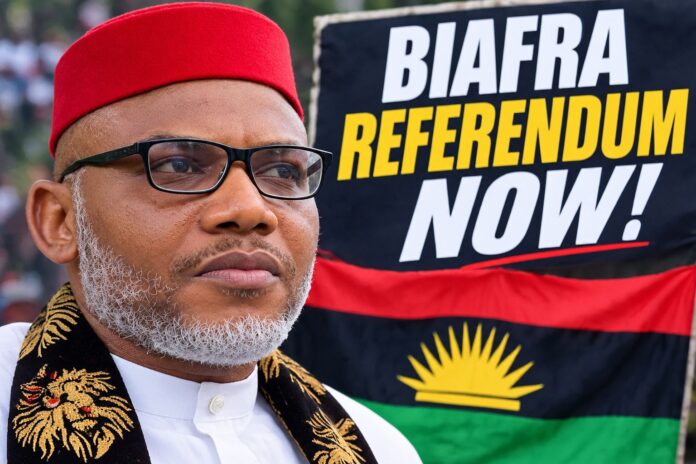
The detained leader of the Indigenous People of Biafra (IPOB), Nnamdi Kanu, has rejected any political compromise that excludes a referendum on Biafran independence, insisting that the people of the region must be allowed to determine their political future through a free vote.
Kanu stated this in an address to the American Veterans of Igbo Descent (AVID) during its annual convention held in Duluth, Georgia, United States, from October 9 to 11, 2026.
In the address, dated September 30, 2026, the IPOB leader maintained that he would not participate in negotiations focused on political appointments, restructuring or conferences that failed to address the question of Biafran sovereignty.
He declared that a referendum on independence remained his primary demand, ruling out alternative arrangements that he believes would leave the central issue unresolved.
“Referendum, or the unilateral pursuit of Biafran sovereignty. There is no middle ground,” Kanu said.
He added that he would not bargain away what he described as the right of his people to determine their political future.
“I will not negotiate the existence of my people. I will not bargain our homeland into a committee. I will discuss referendum and nothing else,” he stated.
Kanu Dismisses Talks Without Referendum
The IPOB leader criticised political discussions that focus on appointments, restructuring and the organisation of conferences without directly addressing the demand for Biafran independence.
According to him, such negotiations would not resolve the fundamental disagreement over the political future of the proposed Biafran state.
He maintained that the people concerned should have the opportunity to decide through a free vote whether they want to remain part of Nigeria or establish an independent country.
Kanu argued that discussions about political concessions would be insufficient if the question of self-determination remained outside the negotiation process.
His position signals a rejection of any settlement that seeks to address the Biafran agitation through political accommodation without considering the referendum he has demanded.
However, a referendum on secession would raise significant constitutional, political and security questions that would need to be addressed through a lawful and peaceful process.
Detention Has Not Changed My Position, Kanu Says
Kanu also maintained that his prolonged detention had not weakened his determination to pursue Biafran independence.
Reflecting on his years in custody, he said his objective remained the establishment of what he described as a peaceful Biafran homeland.
“I have spent eight years of my life in detention in pursuit of the only goal that matters to me, and indeed to all of us: a peaceful homeland called Biafra,” he said.
He insisted that his aspiration was not driven by revenge or a desire to create disorder, but by his vision of a country governed by its own laws.
“Not a slogan. A country. Not revenge. Safety. Not chaos. Order under our own law,” he added.
Kanu’s comments reaffirm his longstanding position that the Biafran question should be addressed through self-determination rather than political negotiations that leave the possibility of independence unresolved.
Kanu Renews Criticism of Nigerian Government and Judiciary
In the address, the IPOB leader also revisited his encounters with Nigerian authorities, including his arrests in 2005 and 2015.
He further accused the Nigerian government of unlawfully bringing him back from Kenya to Nigeria, describing the operation as a kidnapping rather than a lawful arrest.
Kanu has repeatedly challenged the circumstances surrounding his transfer from Kenya, an issue that has featured in his legal proceedings.
He also criticised the judicial process that resulted in his conviction, alleging that the proceedings relied on repealed laws and disregarded an earlier acquittal.
These assertions represent Kanu’s position on his case and have not been independently established by the address itself.
Despite his complaints about the legal process, he insisted that his imprisonment had not altered his ultimate objective.
“The file is open. I am fixated on one goal: total freedom for Biafra,” he declared.
Appeals to Igbo Diaspora Groups
Kanu also urged AVID and other diaspora organisations to sustain their advocacy for his release and that of other individuals he described as Biafrans unjustly detained.
He commended the organisation for its support during his detention and praised its president, Dr Sylvester Onyia, for attending court proceedings and pursuing efforts to secure his release.
According to Kanu, the organisation had also written to British officials, including the Prime Minister and Foreign Secretary, as well as the United Kingdom High Commission in Nigeria, concerning his case.
He urged the veterans to continue their advocacy and invoked the history of Igbo Landing in Georgia, where enslaved Igbo people resisted their enslavement in 1803.
Addressing the convention under the theme Maka Odi Nma Ndi Igbo, meaning “For the Good and Benefit of the Igbo People”, Kanu encouraged participants to draw lessons from the historical episode and apply the principle of self-determination to the Igbo homeland.
He called on the attendees to continue supporting the campaign through what he described as lawful and honourable means.
Biafran Question Remains a Contentious National Issue
Kanu’s latest declaration comes amid continuing debate over the Biafran agitation, separatist movements and the Nigerian government’s responsibility to maintain national unity while addressing concerns about political inclusion and regional grievances.
The demand for Biafran independence remains contentious, with questions surrounding national sovereignty, constitutional provisions, security and the rights of citizens central to the debate.
While Kanu insists that a referendum is the only acceptable basis for negotiations, any move towards such a process would require consideration of Nigeria’s constitutional framework and the positions of relevant political and governmental institutions.
His latest statement leaves little indication of willingness to accept a political settlement that excludes the question of independence.
“I am not available for any bargain that leaves Biafra unnamed,” he said. “I am available for a referendum. I am available for the work of a free people.”
Whether a peaceful political resolution can be reached will depend on the positions of the relevant parties and their willingness to engage within a lawful framework.
