
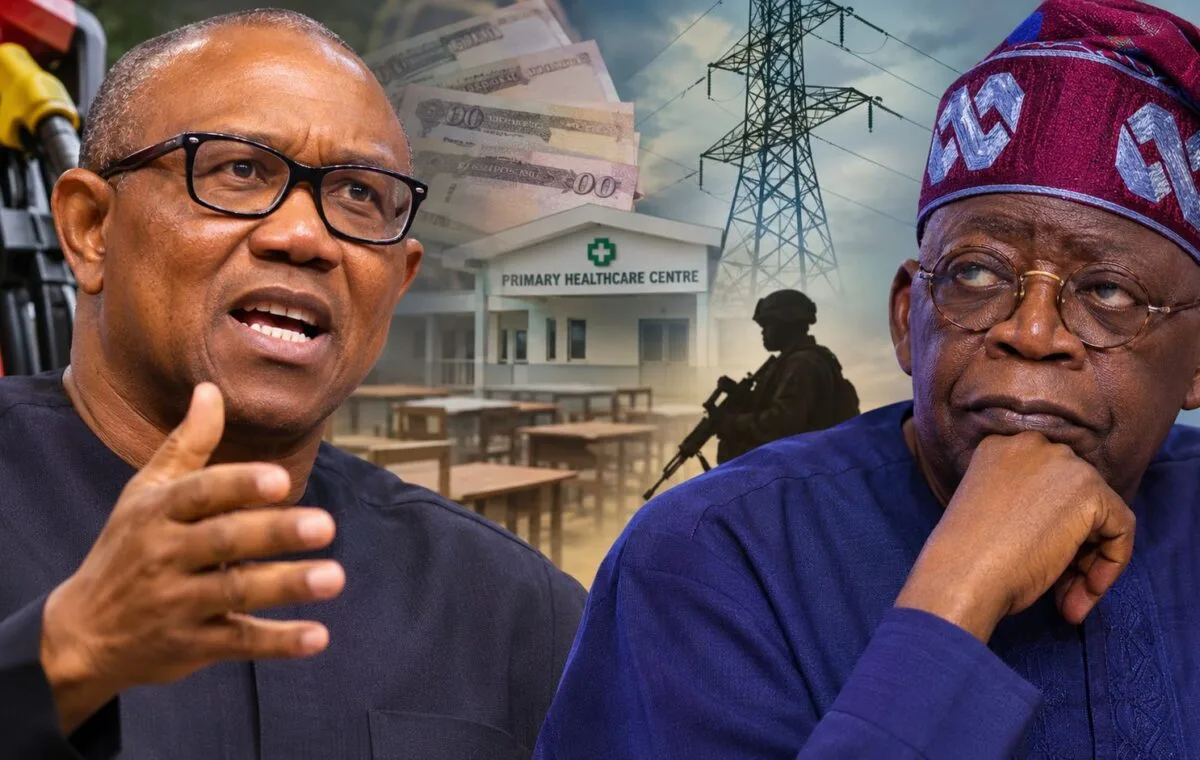
Obi Challenges Tinubu to Account for ₦15.8trn Subsidy Savings, $100bn Borrowings
Peter Obi, presidential candidate of the Nigeria Democratic Congress (NDC), has challenged President Bola Ahmed Tinubu to account for the enormous financial resources that have accrued to his administration, insisting that Nigerians deserve measurable evidence of what has been achieved with public funds.
Obi made the remarks in a post on his official X account on Saturday, November 7, 2026, following Tinubu’s recent visit to Akwa Ibom State, where the President attended a political rally and made comments about the former Anambra State governor’s record on erosion control.
In a pointed message addressed directly to the President, Obi congratulated Tinubu on spending a night in a Nigerian state outside Lagos and Abuja, but used the occasion to question the administration’s record on public spending, borrowing, taxation, poverty reduction, education, healthcare, electricity and national security.
Obi also expressed hope that the President’s experience in Akwa Ibom would encourage him to visit the remaining 33 states of the federation, spend time with ordinary Nigerians and explain what his administration has done with the country’s growing financial resources.
At the centre of his criticism is the estimated ₦15.8 trillion generated from the removal of fuel subsidy, more than $100 billion in borrowings, increased tax revenues and additional government earnings which the administration reportedly celebrated as exceeding its revenue targets.
For Obi, the fundamental question is not how much money the government has generated or borrowed, but what Nigerians have gained from these resources.
THE SUBSIDY QUESTION THAT WILL NOT GO AWAY
One of the most compelling aspects of Obi’s statement is his insistence that the removal of fuel subsidy should not be celebrated in isolation from its consequences for ordinary Nigerians.
The removal of subsidy significantly increased the cost of living, transportation and doing business. Although the government has consistently defended the policy as necessary to stabilise public finances, citizens are entitled to demand evidence that the resources generated have translated into improved public services and economic opportunities.
There is, however, an important distinction in the ₦15.8 trillion figure. The resources accruing from subsidy removal were distributed across the three tiers of government, rather than retained exclusively by the Federal Government.
Nevertheless, the larger accountability question remains valid: what measurable improvements have these additional resources delivered across the country?
FROM BORROWING AND TAXATION TO PUBLIC BENEFITS
Obi also raised concerns about the volume of borrowing and increased taxation under the Tinubu administration.
His argument is that a government generating more revenue, collecting additional taxes and accessing substantial loans should be able to demonstrate corresponding improvements in the lives of citizens.
Borrowing is not necessarily a sign of economic failure, just as increased taxation does not automatically amount to bad economic management. What matters is whether borrowed funds and additional revenues are invested productively, whether they create economic value and whether citizens can identify the benefits.
A government cannot indefinitely ask citizens to endure economic hardship on the promise that difficult decisions will eventually produce prosperity without providing credible evidence of progress.
THE PRESIDENT’S SCORECARD ON POVERTY, EDUCATION AND HEALTHCARE
Perhaps the most consequential part of Obi’s statement is his demand for specific figures on poverty reduction, school enrolment and primary healthcare infrastructure.
How many Nigerians have been lifted out of poverty since May 2023? How many out-of-school children have returned to classrooms? How many functional primary healthcare centres have been constructed or rehabilitated?
These are not abstract political talking points. They are fundamental indicators of national development.
The government may point to its various intervention programmes, student loan scheme and other social investments. However, the existence of a programme is not the same as proof of its effectiveness.
Nigerians need to know how many people have benefited, how much has been spent and what outcomes have been achieved.
ELECTRICITY AND SECURITY: PROMISES MUST BECOME RESULTS
Obi’s reference to electricity is particularly significant because power supply remains one of Nigeria’s most persistent development challenges.
Tinubu previously made a strong political commitment to fixing electricity, telling Nigerians they should not vote for him if he failed to address the problem.
That statement created a standard against which his administration’s performance can be judged.
The question now is whether electricity supply has improved sufficiently to justify the confidence placed in that promise. Businesses continue to require reliable electricity to reduce operating costs, while households remain burdened by the cost of alternative power sources.
Security is another area where the administration must provide a convincing account of its performance.
Despite military operations and government assurances, insecurity continues to threaten communities, livelihoods and economic activities in different parts of the country.
Nigerians deserve credible information about the progress made in reducing terrorism, banditry, kidnapping and other violent crimes.
A PRESIDENTIAL VISIT IS MORE THAN A POLITICAL RALLY
Tinubu’s visit to Akwa Ibom provided an opportunity to engage with citizens and showcase projects executed by the state government. But the occasion also presented an opportunity for a broader conversation about national development.
Obi’s remark about the President spending a night outside Lagos and Abuja was clearly sarcastic, but its underlying message was political: the President must remain connected to the realities of ordinary Nigerians across the federation.
His reference to Tinubu spending more than 260 days outside Nigeria since assuming office was also intended to question the President’s travel priorities and physical engagement with Nigerians at home.
His suggestion that Tinubu should visit the remaining states and explain his administration’s achievements is a challenge to the Presidency to make accountability a regular feature of governance, rather than something reserved for election campaigns.
Indeed, commissioning infrastructure and attending political rallies are legitimate presidential engagements. But they cannot substitute for a comprehensive national scorecard.
THE POLITICAL MESSAGE BEHIND OBI’S STATEMENT
Beyond its economic arguments, Obi’s statement is also a calculated political intervention.
With the 2027 presidential election approaching, the opposition is increasingly attempting to shift the national conversation from the difficult decisions taken by the Tinubu administration to the results those decisions have produced.
This is a strategic challenge for the President.
It is no longer sufficient to argue that subsidy removal was necessary or that previous governments left the country with serious economic problems. The administration must demonstrate what it has achieved with the opportunities and resources available to it since taking office.
Equally, the opposition must be prepared to offer credible alternatives and explain how its proposed policies would produce better outcomes.
Ultimately, the Nigerian electorate should be presented with evidence, competing ideas and measurable records, rather than political attacks and campaign promises.
THE VERDICT: NIGERIANS DESERVE A SCORECARD
Peter Obi’s intervention raises an important question that transcends party affiliations: what has changed in the lives of Nigerians since the Tinubu administration assumed office?
The President has the constitutional responsibility to account for the stewardship of public resources. Nigerians are not asking for a favour when they demand explanations about government spending, borrowing, taxation and public service delivery.
They are exercising their democratic right to hold their elected leaders accountable.
The removal of fuel subsidy may be defended as an economic necessity. Increased revenue may be celebrated as a fiscal achievement. Additional borrowing may be justified as a development strategy.
But none of these, standing alone, constitutes proof of good governance.
The ultimate measure of leadership is not how much money government generates, how many loans it secures or how many promises it makes. It is what those resources achieve for the people.
For a President seeking another mandate, the most convincing campaign material should be a record of demonstrable achievements.
Nigerians deserve more than assurances about a better future. They deserve an account of what has been done with the resources of the present.