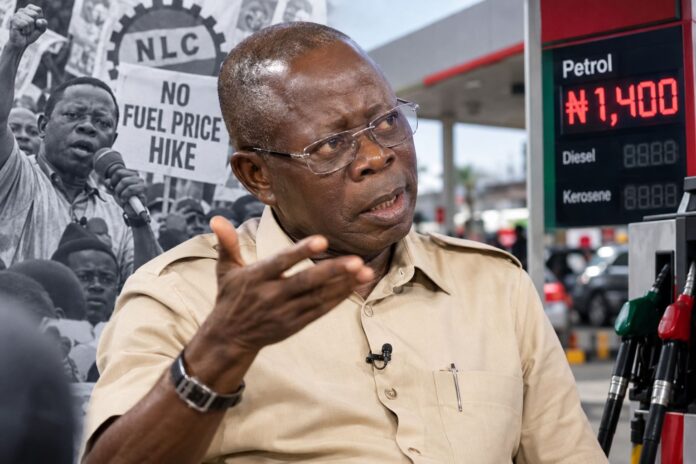
Adams Oshiomhole’s confrontation with an interviewer over Nigeria’s rising petrol prices has reopened an uncomfortable question about political consistency in Nigeria: what becomes of a politician’s principles when the position he once opposed becomes that of the party he now serves?
The former president of the Nigeria Labour Congress (NLC), who earned national recognition for his fierce opposition to fuel price increases under previous administrations, is now a prominent supporter of the All Progressives Congress (APC) government implementing policies that have subjected Nigerians to substantial economic hardship.
His recent interview has brought this contradiction into sharp focus, with the interviewer challenging him to explain why he mobilised Nigerians against relatively small fuel price increases under former President Olusegun Obasanjo but now defends an administration under which petrol prices have risen dramatically.
The question was straightforward. The response, as described in reports of the exchange, did not satisfy critics who expected a direct explanation of the apparent change in position.
For Polity Nigeria, the controversy goes beyond Oshiomhole as an individual. It raises a fundamental question about political accountability: should principles change when political affiliations change?
When Oshiomhole Was the Voice of the Workers
To understand the present controversy, it is necessary to revisit Oshiomhole’s years as NLC president.
During the Obasanjo administration, he emerged as one of the most vocal opponents of fuel price increases, mobilising workers and ordinary Nigerians against policies he believed would worsen their economic conditions.
His opposition was not merely about the price of petrol. It was also about the government’s capacity to manage the proceeds of subsidy removal and ensure that the benefits reached ordinary citizens.
In August 2026, Oshiomhole recalled how he mobilised residents of Ogun State against subsidy removal under Obasanjo. He argued that the government had the capacity to withdraw the subsidy but lacked the necessary mechanisms to guarantee that the poor would benefit from the savings.
That argument was central to his position as a labour leader.
Oshiomhole understood that petrol prices affected far more than motorists. In an economy heavily dependent on road transportation and petrol-powered generators, increases in fuel prices inevitably placed pressure on transport fares, food distribution, production costs and household expenditure.
His activism was built around the conviction that government policies should not impose unbearable sacrifices on citizens without credible assurances of corresponding benefits.
Today, that same argument deserves to be applied to the APC government he supports.
The ₦1,400 Question He Must Answer
During the interview that has attracted public attention, Oshiomhole was challenged over the contrast between his opposition to fuel price increases under Obasanjo and his present support for President Bola Tinubu’s administration, amid petrol prices reported to have reached approximately ₦1,400 per litre in some circumstances.
The interviewer effectively asked why a man who once mobilised Nigerians against a relatively small increase could defend a policy environment associated with such a substantial rise in petrol prices.
The comparison is politically uncomfortable, but it is a legitimate question.
Nigerians have every right to ask whether the arguments Oshiomhole advanced as a labour leader remain applicable today. If he believed that the previous government could not be trusted to distribute the benefits of subsidy removal fairly, what evidence now convinces him that the present government can do better?
If the APC government’s approach is fundamentally different, he should explain those differences clearly.
If he believes the economic circumstances have changed, he should identify the changes and demonstrate how they justify his present position.
What Nigerians deserve is an explanation grounded in evidence, not an expectation that political loyalty should settle the argument.
Reports of the interview described Oshiomhole as agitated during the exchange and noted accusations that he avoided answering the central question directly. Such descriptions should not substitute for a full examination of the footage, but the controversy itself underscores the public’s demand for a convincing explanation.
For someone whose political reputation was strengthened by confronting governments over policies affecting ordinary Nigerians, questions about his own consistency should not be treated as an inconvenience.
Has Oshiomhole Changed His Position or Changed His Standard?
To be fair, Oshiomhole has offered a defence of his position on subsidy removal.
In previous remarks, he argued that the subsidy system had changed significantly from the period when he led the NLC. He has maintained that the cost of sustaining the arrangement had become enormous and that public resources were being consumed by a system he considers vulnerable to abuse.
In a September 2026 report, he argued that the debate should now focus on the opportunity cost of spending trillions of naira on petrol subsidies and questioned whether the arrangement genuinely benefited poor Nigerians.
His argument deserves to be acknowledged. A politician is entitled to revise his position when economic circumstances change, and the historical opposition to subsidy removal does not automatically make every subsequent argument in favour of removal wrong.
However, changing one’s position is different from abandoning the standards previously used to judge government policy.
The central issue is not simply whether subsidy removal is economically defensible. It is whether the government has demonstrated that the policy is being implemented in a way that serves the public interest.
If the subsidy system was objectionable because of corruption, poor management and the failure to deliver benefits to ordinary Nigerians, the removal of the subsidy should be followed by transparent accounting, responsible expenditure and measurable improvements in citizens’ welfare.
The burden of proof does not disappear when a different political party takes over.
Indeed, Oshiomhole’s own historical argument makes scrutiny of the present administration even more important.
Where Are the Benefits Nigerians Were Promised?
When the Tinubu administration announced the end of the petrol subsidy regime in May 2023, the government defended the decision as necessary to free up resources for national development and ease the pressure on public finances.
Oshiomhole subsequently expressed confidence that the administration could address the hardship arising from the policy.
In June 2023, he said the government recognised the immediate discomfort Nigerians were experiencing and argued that savings from subsidy removal could help improve workers’ wages and cushion the rising cost of living.
Those assurances created expectations.
Three years later, the question is whether the implementation has delivered sufficient and demonstrable benefits to justify the sacrifices imposed on Nigerians.
Higher fuel prices have contributed to pressure on transportation and business operating costs. Households have struggled with rising expenses, while small businesses that depend on petrol-powered generators have faced additional financial burdens.
Although subsidy removal is not the sole cause of Nigeria’s economic difficulties, its consequences cannot be separated from the broader cost-of-living crisis.
The government may argue that subsidy removal has improved public revenue and reduced the financial burden of subsidising consumption. Those claims should be examined alongside the quality of public expenditure, the effectiveness of relief measures and the actual benefits reaching citizens.
Oshiomhole should be at the forefront of demanding those answers if his commitment to economic justice remains consistent with the principles he defended as a labour leader.
The savings from subsidy removal should not exist merely as figures in government accounts. Nigerians should be able to identify tangible improvements in infrastructure, healthcare, education, public transportation and social protection.
Otherwise, the argument that the policy is necessary for national development risks becoming another promise whose costs are borne immediately by citizens while its benefits remain difficult to identify.
Political Loyalty Must Not Silence Accountability
One of the greatest weaknesses of Nigeria’s political culture is the tendency of political actors to apply different standards to the same issue depending on who occupies the presidency.
Policies condemned under opposition governments can suddenly become necessary reforms when introduced by a party to which their former critics belong.
This pattern undermines public trust and weakens the quality of democratic accountability.
Oshiomhole’s political evolution from labour leader to governor, APC national chairman and senator is not, in itself, evidence of wrongdoing. Political affiliations can change, and people are entitled to reassess their positions.
But public office comes with a responsibility to explain those changes honestly.
The fact that a politician belongs to the ruling party does not exempt him from answering difficult questions about the consequences of government policies.
Nor should a record of labour activism become a permanent shield against scrutiny. If anything, that record should make consistency more important.
The workers, traders, transport operators and low-income households whose interests Oshiomhole once championed are still confronting the consequences of rising living costs.
Their circumstances have not become less important because the government is now controlled by the APC.
The question is whether the principles that once compelled him to confront those in power still apply when the people in power are his political allies.
Our Position: Explain the Difference, Do Not Evade the Question
Polity Nigeria believes that the controversy surrounding Oshiomhole presents an opportunity for a more substantive debate about fuel policy and political accountability.
The former labour leader should explain, in clear and measurable terms, why he believes the present government’s approach is justified despite the concerns he raised under Obasanjo.
He should address the adequacy of measures to protect vulnerable Nigerians, the transparency of subsidy-related savings, the relationship between government revenue and public welfare, and the extent to which workers’ incomes have kept pace with rising living costs.
He should also explain whether his present position is consistent with the principle he once articulated: that removing a subsidy without ensuring that the benefits reach the poor is an inadequate response to an economic problem.
These questions do not require him to reject the APC or oppose every policy of the Tinubu administration. They require him to demonstrate that his present position rests on defensible economic arguments rather than political convenience.
The government, for its part, should be judged by measurable outcomes rather than assurances alone.
A successful economic policy must ultimately improve the country’s productive capacity and the welfare of its people. Its success cannot be established merely by pointing to the amount of money saved by government while ignoring the burden transferred to households and businesses.
Oshiomhole’s interview has therefore raised an issue larger than a single political exchange. It has highlighted the importance of consistency in a democracy where political actors frequently move between opposition and government.
A politician may change his position, but he owes the public an explanation when that change appears to contradict the principles on which he built his reputation.
For Oshiomhole, the challenge is to demonstrate why the man who once led Nigerians against fuel price increases should now have confidence in a policy environment that has made petrol substantially more expensive.
Until that explanation is convincing, the questions about political consistency will remain.
And in a country where millions of citizens continue to struggle with the cost of living, those questions are not merely political. They are questions of public trust, economic justice and accountability.