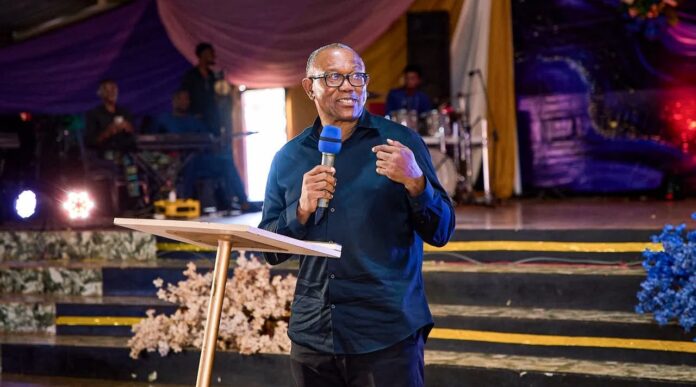
Presidential candidate of the Nigeria Democratic Congress (NDC), Peter Obi, has said he remains convinced that he won the 2023 presidential election, despite acknowledging that he has no evidence to substantiate the claim.
Obi made the disclosure during a recent interview with BBC Africa while responding to questions about his repeated assertion that the 2023 presidential election was not a true reflection of the votes cast by Nigerians.
Asked directly whether he had evidence to prove that he won the election, the former Anambra State governor said: “There’s no evidence. Everything is not based on evidence.”
He nevertheless maintained his position, adding: “I won the election and that’s where I will end.”
Obi contested the February 25, 2023 presidential election on the platform of the Labour Party. The Independent National Electoral Commission (INEC) declared Bola Tinubu of the All Progressives Congress (APC) winner with 8,794,726 votes, followed by Atiku Abubakar of the Peoples Democratic Party (PDP) with 6,984,520 votes. Obi polled 6,101,533 votes.
Obi and the Labour Party subsequently challenged the result at the Presidential Election Petition Court, alleging electoral irregularities and other breaches.
The tribunal dismissed the petition in September 2023, while the Supreme Court in October 2023 dismissed Obi’s appeal and affirmed the lower court’s decision.
Media Adviser: Obi Was Speaking in Legal Context
Reacting to the controversy generated by Obi’s comments, his Media Adviser, Valentine Obienyem, said the statement should be understood in a strict legal context.
According to Obienyem, Obi was referring to evidence capable of meeting the legal standard required by the courts to overturn the declared election result.
“The courts, for whatever reasons, did not consider the evidence presented sufficient to do so,” Obienyem said.
He argued that there was a distinction between evidence sufficient to establish a case in court and circumstances that could lead citizens to draw reasonable conclusions about what happened during the election.
Obienyem pointed to the controversy surrounding the use of technology during the collation process, alleging that the technology used in other elections stopped working during the presidential election at a point when Obi was leading in several results being collated.
He acknowledged, however, that such circumstances might not amount to evidence sufficient to win an election petition in court.
‘Court Has Made Its Final Determination’
Obienyem also acknowledged the finality of the Supreme Court’s decision, saying that, from the perspective of the court, the evidence presented by Obi’s legal team was insufficient to establish the case to the required legal standard.
He maintained, however, that the court’s decision does not prevent Nigerians from continuing to discuss the circumstances surrounding the 2023 election.
“The court determines what has been legally proved, while citizens remain entitled to reason about what they witnessed,” he said.
Obi’s latest comments have consequently reopened public debate over the 2023 presidential election, particularly the distinction between a political claim of victory and the evidence required to establish such a claim before a court.
With Obi now preparing for the 2027 presidential election under the NDC, his comments are likely to keep the 2023 election and its disputed outcome in the political conversation.