
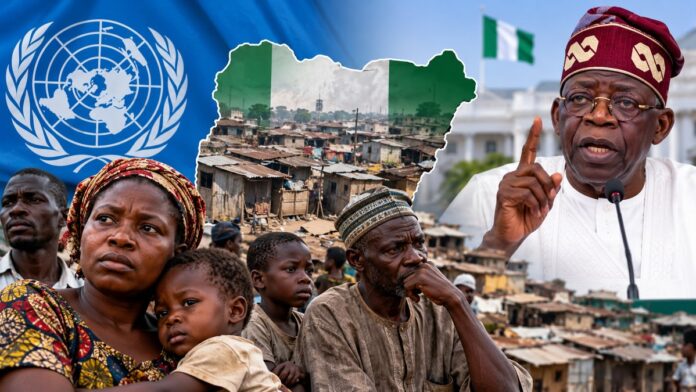
Nigeria’s worsening poverty concerns have returned to the spotlight following the release of the 2026 Global Multidimensional Poverty Index by the United Nations Development Programme (UNDP) and the Oxford Poverty and Human Development Initiative (OPHI).
The report, released on October 12, 2026, estimates that approximately 113 million Nigerians, representing 48.7 per cent of the population covered by the assessment, experience multidimensional poverty.
The findings highlight the difficulties facing millions of households struggling with inadequate access to essential services, including electricity, clean cooking fuel, education, healthcare and other basic necessities.
The report also comes amid renewed debate over the consequences of the Tinubu administration’s economic policies, particularly the removal of petrol subsidies and the unification of the foreign exchange market.
While the Federal Government has defended the measures as necessary to address long-standing economic distortions, the immediate consequences have included increased living costs for households and higher operating expenses for businesses.
The Presidency has now openly acknowledged that more Nigerians fell into poverty during the reform process, arguing that the hardship was an unavoidable consequence of economic restructuring.
UN Report Highlights Nigeria’s Poverty Burden
According to figures reported by Channels Television, the 2026 Global Multidimensional Poverty Index estimates that 113 million Nigerians experience overlapping disadvantages across health, education and living standards.
The report indicates that the average poor Nigerian experiences deprivation in 55 per cent of the weighted indicators used to measure multidimensional poverty, while 28.7 per cent of those classified as poor are considered severely poor.
Unlike monetary poverty measurements, the Multidimensional Poverty Index examines several aspects of people’s living conditions, including nutrition, education, sanitation, electricity and access to safe drinking water.
This means that poverty is assessed not only by how much a person earns but also by whether that person has access to the essential services and resources needed to live a decent life.
The findings underscore the scale of the challenge confronting Nigeria, where millions of households continue to struggle with the cost of food, transportation, healthcare, education and other necessities.
However, the multidimensional poverty figures should not be treated as directly interchangeable with estimates based on income or consumption. The different measures assess poverty using different indicators and reference periods.
Presidency Admits More Nigerians Fell Into Poverty
The latest UN findings come days after Daniel Bwala, Special Adviser to President Tinubu on Policy Communication, acknowledged that the administration’s economic reforms had pushed more Nigerians into poverty.
Speaking during an interview on Channels Television’s Politics Today on October 7, Bwala defended the government’s economic policies while conceding that the measures had imposed significant hardship on Nigerians.
He argued that the increase in poverty was a consequence of the reforms undertaken by the administration and maintained that economic restructuring could not be achieved without some level of discomfort.
Bwala said the government acknowledged that more Nigerians had fallen into poverty but insisted that the administration had made progress since introducing the reforms.
According to him, the government had spent the past three years communicating the progress it believed had been achieved through its economic policies.
The remarks represent an important acknowledgement from the Presidency about the social consequences of the administration’s economic decisions.
However, the assertion that progress has been made raises a separate question: how much of the reported economic improvement has translated into better living conditions for ordinary Nigerians?
The distinction is important because improvements in selected macroeconomic indicators do not automatically mean that households can afford food, pay rent, access healthcare or maintain their previous standard of living.
For millions of Nigerians, the practical test of economic reform remains whether their incomes can adequately cover the rising cost of essential goods and services.
Subsidy Removal, Foreign Exchange Reforms Under Scrutiny
Since assuming office in May 2023, the Tinubu administration has pursued major economic changes, including the removal of petrol subsidies and the unification of the foreign exchange market.
The government has defended the measures as necessary to reduce fiscal pressures, address distortions in the foreign exchange market and create conditions for stronger economic growth.
However, the changes have coincided with significant cost-of-living pressures.
The removal of petrol subsidies increased the direct cost of fuel, with consequences for transportation, food distribution, manufacturing and other economic activities.
The foreign exchange reforms also altered the cost of imported goods and production inputs, placing additional pressure on businesses that depend on imported raw materials, machinery and finished products.
These pressures have been particularly difficult for households whose incomes have not increased sufficiently to match the cost of living.
Small businesses have also faced higher operating expenses, including transportation, electricity, inventory replacement and other production costs.
While the government argues that the reforms are necessary for long-term economic stability, the immediate consequences have intensified the debate over whether adequate protection was provided for vulnerable households during the transition.
The latest poverty findings have therefore renewed attention on the need to assess economic reforms not only through fiscal and financial indicators but also through their effects on employment, household consumption and access to essential services.
Presidency Says Reforms Are Delivering Progress
Despite acknowledging that more Nigerians fell into poverty, the Presidency has maintained that the government’s economic policies are beginning to deliver positive results.
In his October 1 Independence Day address, Tinubu pointed to improvements in selected economic indicators, including declining inflation from its earlier peak, stronger foreign reserves and greater stability in the foreign exchange market.
The President argued that the country was moving from the reform phase towards prosperity, while acknowledging that millions of Nigerians continued to struggle with food, school fees, medical bills and transportation costs.
He also highlighted government interventions aimed at supporting vulnerable households, expanding access to education financing and improving essential public services.
The Federal Government has maintained that the reforms are intended to establish a more sustainable economic foundation and create conditions for stronger growth.
However, the effectiveness of these measures in reducing poverty will depend on whether improvements in economic performance translate into sustained increases in purchasing power, productive employment and access to basic services.
The government’s argument that reforms are necessary for long-term progress does not, by itself, establish that the hardship experienced by households was unavoidable in its full extent or that existing interventions are sufficient.
Those questions require evidence about the scale of deprivation, the reach of social protection programmes and the actual changes in household welfare.
Rural Communities Bear the Heaviest Burden
The multidimensional poverty report also highlights substantial differences between rural and urban communities.
According to figures reported by Channels Television, 68.9 per cent of rural Nigerians experience multidimensional poverty, compared with 24.8 per cent of people living in urban areas.
Severe poverty is also considerably more prevalent in rural communities, affecting 45.1 per cent of rural residents compared with 9.3 per cent in urban areas.
The North-West and North-East regions were identified as areas bearing particularly heavy poverty burdens.
The disparity reflects the challenges confronting communities where access to electricity, healthcare, education, sanitation and other essential services remains limited.
For rural households, inadequate infrastructure can affect agricultural productivity, employment opportunities and access to markets, further limiting their ability to improve their living conditions.
The findings reinforce the importance of targeted interventions that address the needs of underserved communities rather than relying exclusively on broad national programmes.
Electricity and Clean Cooking Remain Major Challenges
The report identifies access to clean cooking fuel and electricity among the significant areas of deprivation affecting Nigerians.
According to figures reported by Channels Television, 47.4 per cent of Nigerians experience poverty alongside deprivation in clean cooking fuel, while 37.6 per cent experience poverty alongside a lack of electricity.
These challenges have consequences for public health, household safety, education and economic productivity.
Dependence on polluting cooking fuels can expose households to harmful smoke, while inadequate electricity can constrain healthcare delivery, small businesses, education and access to digital services.
For entrepreneurs and small business owners, unreliable or unavailable electricity can increase operating costs and limit productive activity.
Addressing these problems requires investment in infrastructure, healthcare, education, sanitation and energy access, alongside measures aimed at improving household incomes.
The findings also demonstrate why poverty reduction cannot be measured solely through changes in national income or other macroeconomic indicators.
A household may experience some improvement in the wider economy while continuing to lack electricity, adequate sanitation, quality education or access to essential healthcare.
Nigeria’s Poverty Challenge Extends Beyond Economic Growth
Nigeria’s poverty situation presents a difficult test for the government’s economic agenda.
While economic growth remains important, its impact on household welfare depends partly on whether the benefits translate into productive employment, stronger purchasing power and improved access to essential services.
The Presidency’s acknowledgement that more Nigerians fell into poverty during the reform process has made the social consequences of the government’s policies an even more prominent issue.
The government maintains that the reforms were necessary to address longstanding economic weaknesses and that progress has been recorded since their introduction.
However, the latest UN findings underline the scale of deprivation that remains to be addressed.
The critical question is whether the government’s claimed economic gains will produce measurable improvements in the lives of Nigerians who continue to struggle with the cost of food, transportation, healthcare, education and housing.
For households already experiencing poverty, the prospect of future economic gains offers limited immediate relief unless accompanied by measures that help them meet essential needs.
The government must therefore demonstrate how its policies will translate into affordable living costs, decent employment, reliable infrastructure and improved access to public services.
It must also ensure that social protection programmes reach the people who need them most and that their effectiveness can be independently assessed.
Ultimately, the success of Nigeria’s economic reforms will depend not only on fiscal stability or improved financial indicators but also on whether they contribute to sustained reductions in poverty and deprivation.
The latest UN report and the Presidency’s own acknowledgement have placed the human consequences of economic reform firmly at the centre of Nigeria’s poverty debate.
For millions of Nigerians, the defining measure of progress remains whether economic changes are making it easier to afford food, access healthcare, educate their children and maintain a decent standard of living.
