The political disagreement between Federal Capital Territory Minister Nyesom Wike and governors elected on the platform of the All Progressives Congress (APC) has intensified ahead of the 2027 general elections, with both sides publicly defending sharply different approaches to President Bola Tinubu’s re-election campaign.
The dispute centres on Wike’s “Rainbow Coalition,” a multi-party political arrangement he says is aimed specifically at mobilising support for President Tinubu’s return to office in 2027.
The APC governors, however, have said they will not participate in or endorse political arrangements that could weaken the ruling party or its candidates in other elections.
How the disagreement started
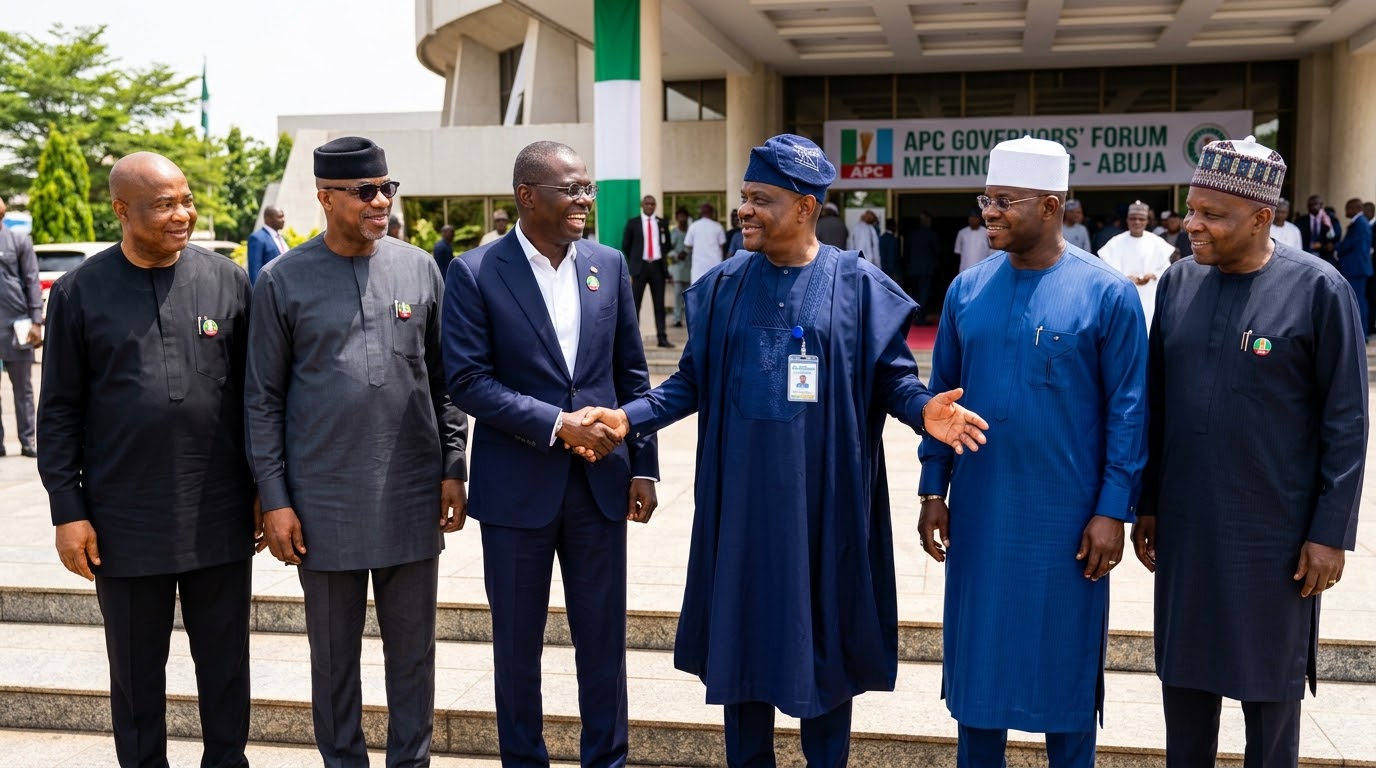
The immediate dispute followed a meeting of the Progressive Governors Forum (PGF), chaired by Imo State Governor Hope Uzodimma, in Abuja on September 14.
Speaking after the meeting, Uzodimma said APC governors had unanimously resolved that they would not participate in, support or endorse an alliance capable of undermining Tinubu’s re-election, weakening the APC or adversely affecting APC candidates.
He further stated that APC governors would support APC candidates at every level of the 2027 elections.
According to the governors, supporting candidates outside the APC could create divided political loyalties and undermine the party’s electoral structure.
The position was widely interpreted as a rejection of Wike’s Rainbow Coalition.
Wike: ‘I never approached APC governors’
Wike has rejected the suggestion that he sought an alliance with the APC Governors Forum.
In an interview with ARISE News, the FCT minister said he had never approached the APC governors to join his coalition.
He said his political objective was straightforward: mobilising support for President Tinubu’s re-election.
“I have never, one day, gone to the APC Forum for an alliance.”
Wike also argued that supporting Tinubu for president does not necessarily mean political parties must abandon their candidates in the governorship, National Assembly or state assembly elections.
He cited situations in which politicians from different political parties could support a presidential candidate while their parties continue to contest other positions.
Wike calls APC governors ‘politically lazy’
The disagreement became more personal when Wike criticised the governors’ position.
He described the APC governors as “politically lazy”, arguing that their interpretation of his coalition demonstrated a misunderstanding of how voters could make different choices at different levels of an election.
Wike also criticised Kwara State Governor AbdulRahman AbdulRazaq, accusing him of repeatedly making him the subject of political disagreements.
Wike’s comments have subsequently triggered reactions from APC figures and groups.
APC figures defend the governors
The latest development on Thursday was a growing response from APC figures who criticised Wike’s attacks on members of the Progressive Governors Forum.
APC chieftain Farouk Aliyu, speaking on Arise Television, described Wike’s remarks against the governors as inappropriate and rejected his criticism of the PGF.
The APC Grassroots Governance Organisation also accused Wike of attempting to create divisions within the ruling party.
The group specifically defended Uzodimma and said the Rainbow Coalition was not an APC organ or campaign structure and did not represent APC governors, candidates or members.
South-East APC backs Uzodimma
The dispute has also drawn a response from APC leaders in the South-East.
The party’s South-East leadership, including its National Vice Chairman and state chairmen from Abia, Anambra, Ebonyi, Enugu and Imo, expressed support for the position taken by the Progressive Governors Forum.
They criticised Wike’s comments about APC governors and argued that elected governors should be allowed to pursue their political interests without interference.
The South-East APC leaders also rejected the Rainbow Coalition as a structure representing the APC.
But some APC figures are asking for dialogue
Not all APC voices have backed the confrontation.
Former House of Representatives member and APC chieftain Abdulmumin Jibrin has urged the APC governors to engage Wike through dialogue rather than publicly attacking him.
Jibrin described Wike as an important political stakeholder in efforts to secure support for Tinubu’s 2027 re-election.
He argued that Wike’s political support for Tinubu has benefited the president and the APC, despite Wike remaining a member of the Peoples Democratic Party (PDP).
Jibrin said that if APC governors believe Wike’s activities could affect their political interests at the state level, they should discuss those concerns directly with him.
What Wike’s coalition actually proposes
At the heart of the disagreement is an important distinction.
Wike’s stated position is that his coalition is not an APC campaign structure.
According to him, it is a platform bringing together politicians and supporters from different political parties who want to support Tinubu’s presidential bid.
He has also maintained that the coalition does not prevent the PDP, Labour Party, APGA or other parties from fielding candidates for governorship and legislative elections.
The APC governors, on the other hand, are approaching the 2027 election from the perspective of party cohesion: their stated position is that APC governors should campaign for APC candidates from the presidency down to state-level contests.
Why the dispute matters
The disagreement exposes a potential tension between support for a presidential candidate and loyalty to a political party’s candidates at other levels.
For Wike, the 2027 presidential contest can involve support crossing party boundaries.
For the APC Governors Forum, the party’s presidential campaign is connected to its campaigns for governors, senators, House of Representatives members and state lawmakers.
That difference could become particularly significant in states where politicians supporting Tinubu belong to parties competing against APC candidates in other races.
For now, neither side has indicated that it is abandoning its position.
The dispute therefore remains part of the broader political realignment taking shape ahead of Nigeria’s 2027 elections.