
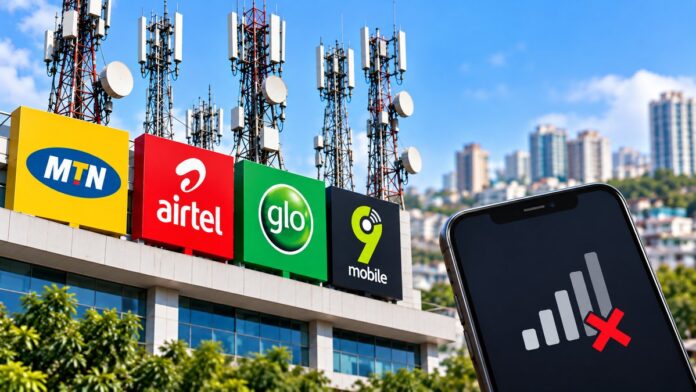
Nigeria’s telecommunications industry is facing renewed scrutiny over service quality after fresh figures showed that mobile network operators and tower companies invested a combined ₦2.53 trillion in network infrastructure in 2025, yet consumers continued to report persistent problems with calls, internet connectivity and billing.
The development highlights the growing disconnect between investment in telecommunications infrastructure and the experiences of millions of Nigerians who depend on mobile networks for communication, banking, education, business transactions and access to digital services.
According to a report published by The Guardian Nigeria on October 10, data from the Nigerian Communications Commission (NCC) showed that the country’s four major mobile network operators recorded 413,587 consumer complaints during the first half of 2026.
The complaints covered poor voice and data quality, billing disputes, unexpected data depletion, failed payment transactions and SIM-related issues.
The figures emerged amid growing expectations that increased spending on network infrastructure should translate into more reliable and affordable telecommunications services for subscribers.
Airtel, MTN Lead Consumer Complaints
The NCC data showed that Airtel Nigeria recorded the highest number of complaints during the six-month period, with 228,992 cases.
MTN Nigeria followed with 124,405 complaints, while Globacom recorded 56,810. T2mobile, formerly known as 9mobile, accounted for 3,885 complaints.
Combined, the four operators recorded 413,587 complaints between January and June 2026.
However, the regulator reported that 406,938 complaints had been resolved, representing a resolution rate of 98.38 per cent.
While the reported resolution rate indicates that operators addressed the overwhelming majority of recorded complaints, it does not, by itself, establish whether subscribers received satisfactory remedies or whether the underlying service problems were permanently corrected.
The figures also represent recorded complaints rather than the total number of subscribers who experienced network difficulties. They should therefore not be interpreted as a direct measure of the proportion of customers dissatisfied with each operator.
Nevertheless, the volume of complaints underscores the importance of effective customer service and consistent compliance with established quality-of-service standards.
₦2.53 Trillion Invested in Network Infrastructure
The telecommunications industry’s investment figures indicate that operators and tower companies have committed substantial resources to expanding and upgrading Nigeria’s communications infrastructure.
According to the report, the Association of Licensed Telecom Operators of Nigeria said operators and tower companies collectively invested ₦2.53 trillion in network infrastructure in 2025.
A further ₦1.86 trillion was earmarked for 2026, reflecting continued efforts to expand coverage, upgrade existing facilities and accommodate increasing demand for voice and data services.
The NCC also disclosed that operators had committed to adding or upgrading more than 12,000 telecommunications sites during 2026.
These investments are intended to improve network capacity, strengthen coverage and support the growing volume of data traffic generated by Nigerian consumers.
MTN Nigeria, for instance, reportedly spent ₦620.5 billion on capital expenditure during the first half of 2026. The company has also deployed substantial resources towards expanding its network infrastructure.
Airtel has invested in coverage expansion and preparations for wider 5G deployment, while Globacom has embarked on network upgrade projects involving new 4G LTE base stations and fibre infrastructure.
However, the persistence of consumer complaints demonstrates that infrastructure investment must be assessed alongside measurable improvements in service delivery.
For subscribers, the most immediate indicators of progress remain reliable calls, stable internet connections, transparent billing and dependable transactions.
Rising Data Demand Puts Pressure on Networks
One factor complicating efforts to improve telecommunications services is the rapid growth in data consumption.
As Nigerians increasingly rely on smartphones for digital payments, video streaming, social media, remote work, online learning and business operations, pressure on telecommunications infrastructure continues to rise.
The Guardian reported that data traffic on MTN’s network increased by 25.8 per cent in the first half of 2026, while average monthly data consumption per subscriber rose by 15.2 per cent to 14.8 gigabytes.
National data consumption also reached approximately 1.66 million terabytes in July 2026, representing an increase of about 43.6 per cent compared with the corresponding period in 2025.
The figures illustrate the scale of demand facing operators as mobile internet becomes increasingly central to everyday economic and social activities.
Consequently, additional investment may be necessary not only to improve existing services but also to prevent network congestion as demand expands.
Nevertheless, growing demand does not remove operators’ responsibility to provide services that meet applicable regulatory standards and to communicate transparently with customers when disruptions occur.
Fibre Cuts, Vandalism and Infrastructure Challenges
Telecommunications industry representatives have also identified persistent infrastructure challenges that affect network reliability.
These include fibre-optic cable cuts, vandalism, theft of telecommunications equipment and difficulties accessing some network sites.
Fibre cuts can disrupt connectivity across several locations, while vandalism and equipment theft can increase maintenance costs and delay restoration of services.
The industry has also faced the challenge of protecting telecommunications infrastructure from damage caused by road construction and other public works.
These problems demonstrate that improving network quality requires cooperation among telecommunications operators, government agencies, construction companies, security institutions and other stakeholders.
Operators must continue investing in resilient infrastructure and maintenance, while public authorities need to ensure that telecommunications facilities receive adequate protection during construction projects and other activities that could damage essential network equipment.
NCC Introduces Compensation for Poor Service
In an effort to strengthen consumer protection, the NCC introduced an automatic airtime compensation framework that took effect in April 2026.
Under the framework, eligible subscribers in affected locations can receive compensation when operators fail to meet prescribed quality-of-service standards.
The initiative is intended to provide a more direct remedy for customers affected by qualifying network deficiencies rather than leaving them to pursue individual complaints in every case.
According to the October 10 report, the commission was engaging independent auditors to verify operators’ compliance with the directive.
MTN had also begun notifying eligible subscribers about airtime credits relating to qualifying network deficiencies recorded between February and April 2026. The reported credits ranged from ₦20 to ₦1,436.
The compensation initiative represents an attempt to connect network performance with tangible consequences for operators.
However, its effectiveness will depend on transparent implementation, accurate identification of affected subscribers and reliable verification that eligible customers receive the compensation due to them.
The regulator will also need to communicate clearly about the locations and service failures covered by the framework so that consumers understand when they qualify.
Investment Must Translate Into Better Service
Nigeria’s telecommunications industry remains central to the country’s digital economy, supporting financial transactions, commerce, education, communication and access to essential information.
The sector’s substantial capital expenditure is important because expanding network capacity requires continuous investment, particularly as demand for mobile internet rises.
However, the investment figures and complaint statistics reveal two sides of the industry’s current challenge: operators are spending heavily to expand infrastructure, while consumers continue to report problems that affect their daily activities.
The reported resolution of 98.38 per cent of complaints is a significant operational indicator, but it should be considered alongside the recurrence of network failures, the quality of remedies offered and independent measurements of service performance.
For the NCC, the task is to ensure that investment commitments translate into verifiable improvements in connectivity and that operators comply with consumer-protection requirements.
For telecommunications companies, improved network reliability, transparent billing and responsive customer service remain essential to maintaining consumer confidence.
Ultimately, the success of Nigeria’s telecommunications investment drive should not be measured solely by the amount of money committed to infrastructure or the number of network sites deployed.
It should also be measured by whether subscribers can make calls, browse the internet, complete transactions and conduct business without persistent disruptions.
Until improvements become consistently visible to consumers, the question of whether massive telecommunications spending is delivering sufficient value to subscribers will remain a central issue for Nigeria’s digital economy.
