
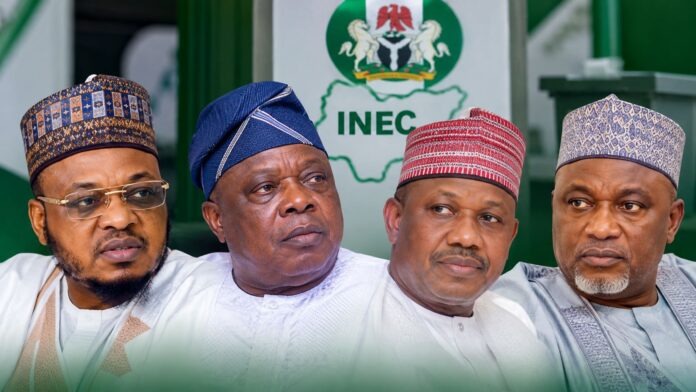
The Independent National Electoral Commission (INEC) has reportedly attributed the exclusion of some governorship candidates from its final list to compliance with the Electoral Act 2026 and the Supreme Court’s September 24 judgment on political party membership registers and candidate nominations.
According to a report by The Nation, an unnamed senior INEC official disclosed that the commission reviewed the provisional lists of governorship candidates alongside the electronic membership registers submitted by political parties before releasing the final list on Saturday.
The source said the affected candidates were omitted because their names could not be found in the membership registers submitted by the parties that nominated them.
Among the candidates reportedly excluded are Isa Ali Pantami, the Peoples Democratic Party (PDP) governorship candidate in Gombe State; Oladipupo Adebutu, the PDP candidate in Ogun State; Abdulsalam Gwarzo, the Nigeria Democratic Congress (NDC) candidate in Kano State; and Danjuma La’ah, the NDC candidate in Kaduna State.
The Social Democratic Party (SDP) has also alleged that four of its candidates were omitted from the final list, raising concerns about the implications of the commission’s decision for the affected parties.
INEC Source Cites Supreme Court Judgment
The development follows the Supreme Court’s September 24, 2026 judgment on provisions of the Electoral Act 2026 relating to political party membership registers and candidate nominations.
The relevant provisions include Sections 77(5), 77(6) and 77(7), which address party membership registers, participation in party primaries and the consequences of non-compliance with statutory requirements.
Section 84(2) also addresses procedures for nominating candidates through direct primaries or consensus.
According to The Nation, the unnamed INEC official said the commission reviewed the candidates’ details against the electronic membership registers submitted by their respective political parties before finalising the list.
The source reportedly maintained that some politicians had failed to meet the applicable legal requirements, adding that INEC had decided to ensure its actions and decisions complied with the law following the Supreme Court judgment.
The official was quoted as saying that the affected candidates’ names could not be found in the membership registers submitted by the parties that nominated them.
The explanation suggests that compliance with electoral requirements informed the commission’s reported decision. However, the precise legal implications for each candidate depend on the applicable provisions and the circumstances surrounding the party’s membership records and nomination process.
PDP Gives INEC 48-Hour Ultimatum
Meanwhile, the PDP has reportedly given INEC 48 hours to explain why some of its governorship candidates were omitted from the final list.
The party warned that it would determine its next course of action if the commission failed to provide an explanation within the stipulated period.
The ultimatum reflects the growing concerns among affected political parties over the omissions and their potential implications for participation in the forthcoming governorship elections.
The dispute also places renewed attention on the responsibility of political parties to comply with statutory requirements governing membership registers and candidate nominations.
Legal Implications of the Exclusions
The controversy raises questions about how the Electoral Act’s membership register provisions apply to the affected candidates and whether the commission correctly applied the law in each case.
Although an unnamed INEC source reportedly linked the exclusions to the Supreme Court judgment, the explanation has not been independently established in this report as an official statement issued by the commission.
The affected parties may seek further clarification from INEC and consider the legal options available to them.
As the dispute unfolds, the commission’s formal response and any subsequent legal proceedings could provide greater clarity on the basis for the exclusions and their implications for the affected candidates.
