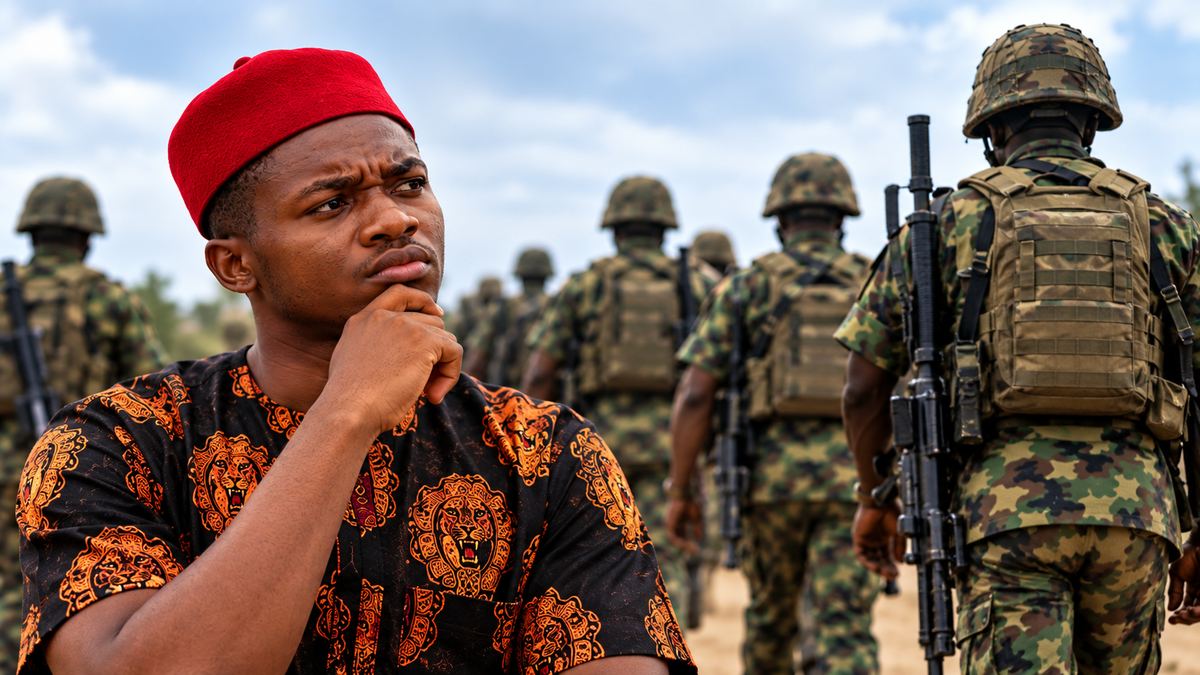
Calls for Igbo youths to enlist in the Nigerian Armed Forces have continued to attract scepticism from sections of the South-East, with some young people questioning why they should risk their lives for a country they believe has yet to guarantee them equal opportunities in political leadership, public employment and national development.
For these youths, the controversy goes beyond military recruitment. It touches on concerns about the welfare of soldiers, alleged ethnic marginalisation, representation in strategic federal institutions, the possibility of an Igbo presidency and the controversial government policy of rehabilitating former Boko Haram insurgents.
Their arguments, reflected in public discussions and social media reactions, raise a fundamental question about patriotism and citizenship: why should young people be expected to risk their lives defending a country when they believe their own security, political inclusion and future remain uncertain?
‘Why Should We Become Shields for Others?’
One of the recurring concerns expressed in the debate is the fear that young Igbo men could be recruited into the military only to be deployed to dangerous operational theatres where they would face the risk of death.
Some social media commentators have questioned whether the government is doing enough to protect soldiers fighting insurgency, terrorism and banditry across the country.
Their concerns centre on military casualties, the dangers of frontline operations and whether soldiers receive adequate equipment, medical attention, insurance and compensation for injuries or death in service.
For these critics, patriotism should not mean accepting avoidable risks without assurances that the government will protect personnel and support their families if tragedy occurs.
The argument has also produced a more provocative question: why should Igbo youths volunteer to become what they describe as human shields for a country in which they feel politically excluded?
These expressions reflect the distrust voiced by some participants in the debate. They should not, however, be interpreted as the position of every Igbo youth or as proof that the military deliberately recruits personnel from any particular ethnic group to serve as shields.
Nevertheless, the concerns highlight the importance of military welfare, equitable treatment and public confidence in the institutions responsible for national security.
Poor Welfare Raises Questions About the Value of Military Service
Beyond concerns about deployment, military welfare has emerged as another important issue in the recruitment debate.
Some prospective recruits and social media commentators question whether the financial and professional benefits of military service justify the risks involved.
Their concerns include salaries, accommodation, healthcare, insurance, equipment and the treatment of soldiers who sustain injuries or lose their lives while serving the country.
For young people facing unemployment and economic uncertainty, the decision to join the military involves weighing the benefits of a stable career against the possibility of being deployed to dangerous areas.
Some argue that the government cannot expect enthusiastic recruitment while questions about the living conditions of military personnel and the support available to their families remain unresolved.
The government and military authorities, therefore, face the challenge of demonstrating that service personnel receive the protection, remuneration and professional support they deserve.
Allegations of Marginalisation in Military Leadership and Federal Jobs
Another major argument in the debate concerns what some Igbo commentators describe as the region’s marginalisation in strategic federal institutions.
Critics question why young people should be encouraged to join the Armed Forces when they believe that people from their region face disadvantages in accessing opportunities within the military, other security agencies and influential federal institutions.
Some have extended the argument beyond military recruitment to appointments and employment opportunities in federal establishments.
Their position is that national integration cannot be achieved merely by asking people from an underrepresented region to participate in institutions without addressing their concerns about fairness, recruitment transparency and career advancement.
Questions have also been raised about access to military training institutions, including the Nigerian Defence Academy, where successful candidates can pursue careers leading to commissioned officer positions.
These allegations require examination against recruitment records, admission data and official appointment figures. Nevertheless, their continued appearance in public debate highlights the importance of transparency in federal recruitment and promotion.
For some critics, the central question is whether an Igbo recruit can expect the same opportunities for advancement as a recruit from any other part of the country.
Repentant Boko Haram Fighters: Why Should We Trust Them With Arms?
Another issue that could further complicate efforts to persuade Igbo youths to enlist is the controversy surrounding the rehabilitation and reintegration of former Boko Haram insurgents.
Some Nigerians have questioned the government’s approach to individuals who previously participated in an insurgency responsible for years of killings, displacement and destruction in the North-East.
Their concerns have become particularly pronounced whenever claims circulate on social media alleging that former insurgents are being recruited, armed or deployed alongside Nigerian troops.
For some commentators who already distrust the government and its security institutions, the possibility that former terrorists could be entrusted with weapons raises difficult questions about national security and the sincerity of their purported repentance.
They ask: If young Nigerians are being urged to join the military and risk their lives fighting terrorism, why should individuals who previously participated in terrorist activities be considered for rehabilitation without convincing assurances that they have genuinely abandoned their former ideology?
The concern is not simply about whether former insurgents deserve a second chance. It is also about accountability, public safety and the criteria used to determine whether someone who once participated in an armed extremist organisation has genuinely renounced violence.
Some critics believe that the government must demonstrate that rehabilitation programmes do not undermine the sacrifices of soldiers and civilians who suffered at the hands of insurgents.
They also question whether victims and affected communities receive sufficient attention, justice and support when former insurgents are given opportunities to return to society.
These questions resonate with broader concerns about fairness: why should people who have risked their lives defending the country believe that the government is treating their sacrifices and the actions of former insurgents with appropriate seriousness?
What the Military Says
However, the allegation that repentant Boko Haram fighters are being absorbed into the Nigerian military must be distinguished from the established purpose of the government’s rehabilitation programme.
In April 2026, the military, through Brigadier General Yusuf Ali, coordinator of Operation Safe Corridor, rejected claims circulating on social media that repentant and active Boko Haram members were being armed and deployed alongside Nigerian troops.
The military described the allegations as false and misleading, explaining that Operation Safe Corridor was designed for the deradicalisation, rehabilitation and reintegration of screened former insurgents, not their recruitment into combat operations.
The federal government had also previously denied that graduates of the programme were being absorbed into the Armed Forces. In August 2020, the Presidency stated that none of the 601 former Boko Haram members who had completed the rehabilitation programme at that time was being recruited into the military.
The distinction is important. Public suspicion about former insurgents being recruited into the military does not, by itself, establish that such recruitment has taken place.
Nevertheless, the persistence of these allegations demonstrates the difficulty authorities face in building public confidence in rehabilitation programmes.
For some Nigerians, the government must do more to communicate how participants are screened, how their activities are monitored after rehabilitation and what safeguards prevent individuals who remain committed to violence from exploiting reintegration initiatives.
The government must also recognise that rehabilitation, accountability and the welfare of victims are separate but interconnected issues. Addressing one does not automatically resolve the others.
For young people already questioning whether they can trust the state to protect them, the controversy provides another reason to demand greater transparency from the institutions seeking their participation.
The Presidency Question: Why Is Their Political Future in Doubt?
Perhaps the most politically sensitive aspect of the debate is the question of Nigeria’s presidency.
Some Igbo youths and commentators have questioned why they should be expected to demonstrate extraordinary commitment to national institutions when political conversations across the country continue to feature arguments suggesting that an Igbo person may never become president.
Their frustration reflects a contradiction they perceive in the country’s approach to national unity: they are urged to serve the federation, defend its territorial integrity and risk their lives for its survival, yet they believe the possibility of producing a president remains a subject of persistent ethnic and political controversy.
The question they are asking is straightforward: If Igbo youths are Nigerian enough to defend the country with their lives, why should the possibility of an Igbo person becoming president remain a source of resistance or controversy?
For these commentators, the presidency represents more than an individual political ambition. It is a symbol of equal citizenship, political inclusion and the assurance that no ethnic group is permanently excluded from the country’s highest office.
Nigeria’s Constitution does not prohibit an Igbo person or any other Nigerian ethnic group from producing a president. Eligibility is governed by constitutional requirements, including citizenship, age, party sponsorship and other qualifications.
However, constitutional eligibility does not automatically eliminate political barriers, ethnic prejudice or disagreements over power-sharing.
Consequently, the argument advanced by these critics is not necessarily that military recruitment should depend on which ethnic group occupies the presidency. Rather, they are questioning what they see as an imbalance between the sacrifices expected of citizens and the political opportunities they believe are available to them.
Their position is that national unity becomes difficult to sustain when some citizens feel that they are expected to make sacrifices for a country whose highest political office appears, in their perception, to be beyond their reach.
Historical Grievances Continue to Influence Public Perception
The Nigerian Civil War and its aftermath remain important reference points in discussions about relations between the South-East and the federal government.
For some younger people who did not experience the war, historical grievances have been transmitted through family accounts, political discussions, community narratives and social media.
More recent security operations and allegations of abuses involving people suspected of supporting separatist movements have also contributed to mistrust among some sections of the population.
These historical and contemporary experiences influence how some young people interpret government appeals for greater participation in national institutions.
However, the experiences and opinions of Igbo youths are not uniform. Some support greater participation in the Armed Forces, while others argue that unresolved concerns about security, political representation and equal treatment must be addressed.
Understanding these different perspectives is important to any serious discussion about the region’s recruitment figures.
Is Rejecting Military Recruitment the Answer?
Not everyone agrees with the argument that Igbo youths should reject military recruitment.
Some political leaders and commentators have warned that continued disengagement could further reduce the region’s representation in the Armed Forces and make it more difficult for qualified people from the South-East to rise through the ranks.
The argument is that if qualified applicants consistently avoid recruitment, the region could lose opportunities to influence military institutions from within.
Supporters of greater participation also argue that military service can provide professional training, stable employment and opportunities to contribute to national security.
These arguments present a strategic dilemma for young people in the region: refusing to participate may express dissatisfaction, but it could also leave the institutions they criticise with fewer people from their communities.
Conversely, insisting on participation without addressing legitimate concerns about welfare, fairness and trust may do little to encourage recruitment.
The challenge, therefore, is not simply to persuade Igbo youths to enlist. It is to create conditions under which military service is seen as a credible, fair and professionally rewarding career choice.
The Government Must Address the Questions Behind the Refusal
The recruitment debate presents an opportunity for the federal government and military authorities to examine the concerns being raised by prospective applicants rather than dismissing them as evidence of disloyalty.
First, the government should provide clear information about military salaries, insurance, death benefits, medical support, accommodation and assistance for the families of personnel killed or injured in service.
Second, recruitment and admission processes should be transparent, with accessible data showing applications, successful candidates, regional representation and the criteria used to select applicants.
Third, military promotion and appointments should be governed by demonstrable professional standards, with credible mechanisms for addressing allegations of discrimination.
Fourth, the government should clearly communicate the safeguards surrounding Operation Safe Corridor, including the distinction between rehabilitation and military recruitment, screening procedures and the monitoring of former insurgents after their reintegration into society.
Fifth, the government should examine wider concerns about representation in federal employment and strategic public institutions, ensuring that qualified Nigerians from every geopolitical zone have fair opportunities.
Finally, national leaders should confront the ethnic hostility that surrounds conversations about presidential eligibility and political power-sharing.
An inclusive federation must be capable of reassuring every citizen that national service does not depend on ethnic identity and that no group is permanently excluded from political leadership.
Conclusion
The reluctance of some Igbo youths to join the Nigerian military has developed into a broader argument about trust, citizenship, welfare and political inclusion.
For those expressing dissatisfaction, the question is not simply whether they are willing to defend Nigeria. It is whether Nigeria is equally committed to protecting their lives, respecting their rights and providing them with opportunities to participate fully in national affairs.
Their concerns about becoming frontline casualties, receiving inadequate welfare, facing discrimination, remaining politically marginalised and questioning the government’s handling of former Boko Haram insurgents deserve serious examination.
At the same time, allegations that former insurgents are being recruited into the military must be assessed against verifiable evidence and the military’s official position. Public debate is strengthened, rather than weakened, when genuine concerns are separated from unsubstantiated claims.
The long-term interests of the South-East may also require careful consideration of whether disengagement from national institutions will improve representation or further limit it.
Ultimately, military recruitment cannot be separated entirely from public confidence in the institution and the country it serves.
If the government wants more young people from the South-East to enlist, it must do more than appeal to patriotism. It must demonstrate through transparent recruitment, fair career progression, improved welfare, credible security safeguards and inclusive governance that every Nigerian’s life, service and political aspirations matter.
For a country seeking unity, the question is not only why some Igbo youths are reluctant to enlist. It is also what the country must do to convince them that they belong.