
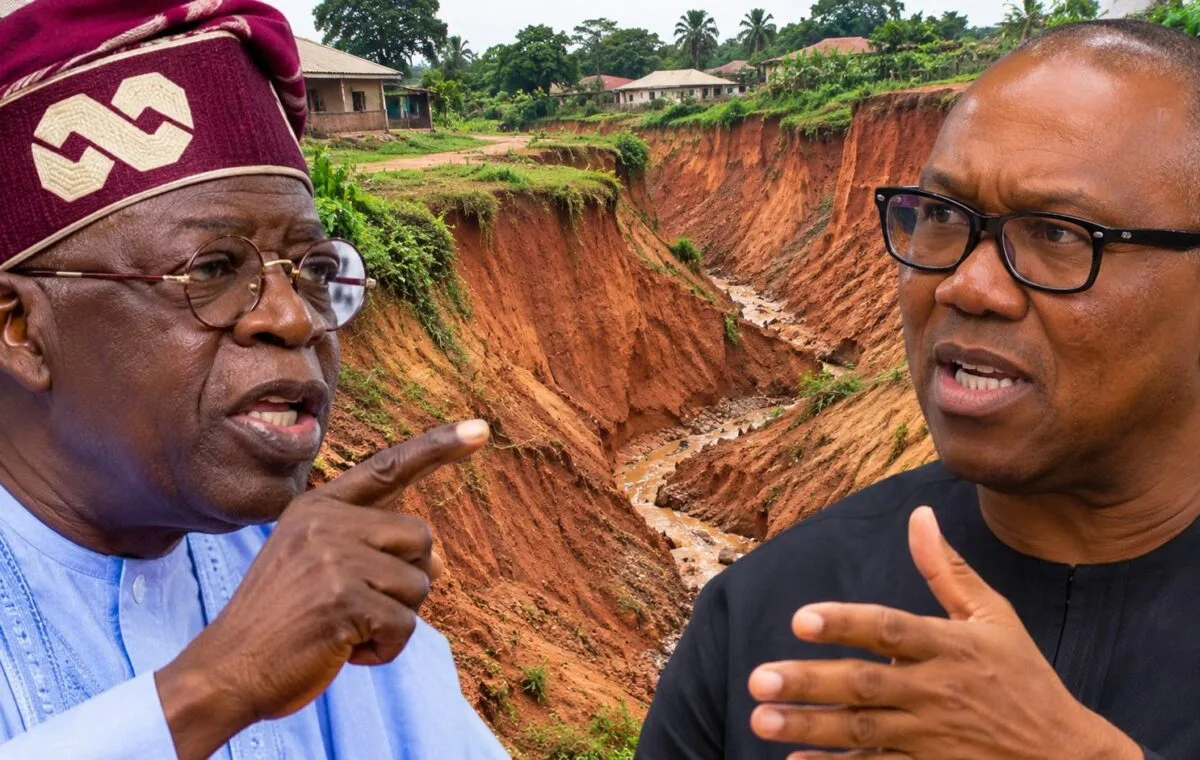
Anambra Erosion: Obi Replies Tinubu, Says He Helped Develop Control Programme
NDC presidential candidate Peter Obi has responded to President Bola Tinubu’s criticism of his record on erosion control in Anambra State, insisting that he played a significant role in developing the intervention programme currently being used to tackle the environmental challenge.
Obi described Tinubu’s allegation that he failed to confront erosion during his tenure as Anambra governor as untrue, saying he personally approached former President Umaru Musa Yar’Adua to seek intervention over the problem.
The former Anambra governor spoke on Tuesday, November 10, 2026, during an interview on Rhythm FM Jos, ahead of the NDC town hall meeting in Plateau State.
Responding to Tinubu’s remarks at an All Progressives Congress (APC) rally in Uyo, Akwa Ibom State, Obi said he worked with a former Minister of Environment to develop the erosion-control programme.
“On what the president said while campaigning in Akwa Ibom, it’s not true. I, working with the former minister of environment, developed what they’re using today to fight erosion,” Obi said.
He explained that he had taken a proposal on the erosion crisis to Yar’Adua, who subsequently directed the then Minister of Environment to develop the initiative.
“I went to President Yar’Adua, made a suggestion to him. He called the minister and said he should go and develop it,” he added.
What Tinubu Said About Obi
Tinubu had taken a swipe at Obi during an APC rally in Uyo on Friday, November 6, accusing the former Anambra governor of failing to tackle erosion in his state.
The President contrasted Obi’s record with his own environmental interventions in Lagos, declaring that while the NDC presidential candidate could not confront erosion in Anambra, he confronted the Atlantic Ocean.
“In Anambra State, he could not confront erosion. I, Bola Ahmed Tinubu, confronted the Atlantic Ocean,” Tinubu had said.
The President’s comments formed part of his criticism of Obi’s leadership credentials as political activities intensify ahead of the 2027 presidential election.
Records Show Obi’s Involvement in NEWMAP
Historical records provide some backing for Obi’s claim of involvement in efforts to secure intervention for erosion-prone communities in the South-East.
In September 2014, former Minister of Environment John Odey credited Obi with playing an instrumental role in advancing the Nigeria Erosion and Watershed Management Project (NEWMAP).
Odey recalled that Obi had almost single-handedly pushed for the project despite lukewarm responses from some of his colleagues.
The World Bank’s then Country Director, Marie-Françoise Marie-Nelly, also commended Obi for his commitment to the initiative, noting that Anambra was the first state to pay its ₦500 million counterpart contribution.
However, NEWMAP was a federal government programme supported by the World Bank, rather than a project independently established by Obi.
The initiative was designed to address severe soil erosion, land degradation and related environmental challenges across several Nigerian states, including Anambra.
Did NEWMAP Solve Anambra’s Erosion Problem?
Despite the intervention, erosion remains a major environmental challenge in Anambra, with several communities continuing to face threats from expanding gullies and land degradation.
A 2021 investigation by the International Centre for Investigative Reporting (ICIR) documented implementation gaps at some erosion-control sites in the state, raising concerns about project delivery and the extent of progress achieved.
Nevertheless, subsequent reports indicated that several sites received interventions, with the Anambra NEWMAP project coordinator reporting in 2025 that 13 sites had been completed.
The records suggest that although interventions were undertaken during and after Obi’s administration, the scale of the erosion crisis has continued to exceed the reach of the projects.
Obi’s response therefore challenges Tinubu’s suggestion that his administration failed to confront the problem, although the effectiveness and adequacy of the interventions remain separate issues.
The exchange adds another dimension to the growing political contest between Tinubu and Obi ahead of the 2027 presidential election, with both political figures increasingly using their records in public office to question each other’s capacity to lead the country.