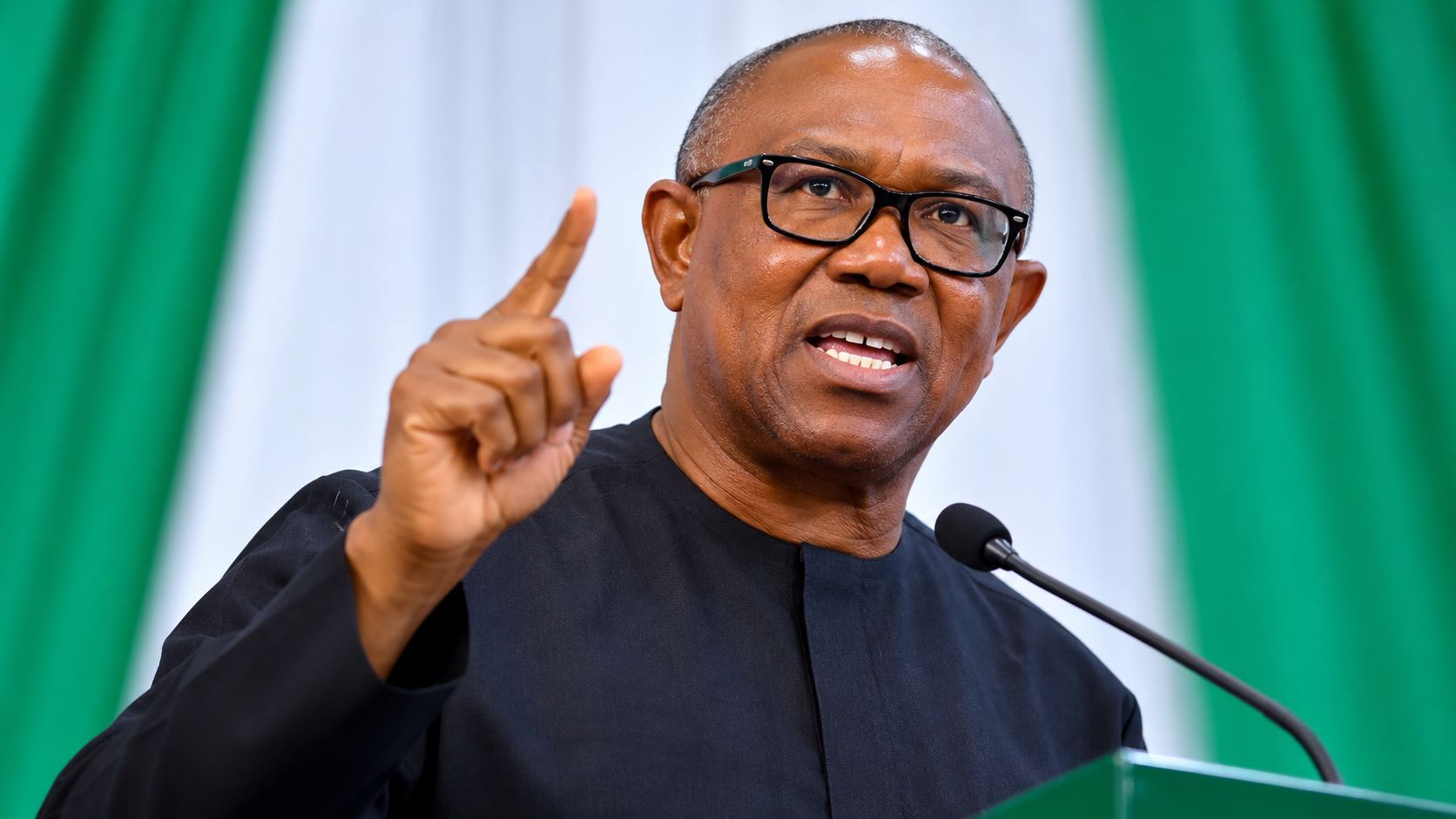
Former Anambra State Governor and Nigeria Democratic Congress (NDC) presidential candidate, Peter Obi, has criticised President Bola Tinubu’s economic policies, arguing that improvements in Nigeria’s macroeconomic indicators have yet to translate into better living conditions for millions of citizens.
Obi made the remarks in a statement titled “Celebrating Macroeconomic Stability Amidst Increasing Poverty”, published on Monday, October 12, in reaction to the World Bank’s latest assessment of Nigeria’s economic performance.
The former governor argued that improvements in economic growth, government revenue and foreign reserves should not be mistaken for evidence that Nigerians are experiencing improved living standards.
According to him, the effectiveness of economic reforms should be measured by their impact on poverty reduction, job creation and inequality rather than by economic statistics alone.
He maintained that despite the reported improvements in some macroeconomic indicators, many Nigerians continue to struggle with the rising cost of living, inadequate access to basic necessities and limited employment opportunities.
“An economy is not truly stabilized simply because government revenue increases, foreign reserves strengthen, or GDP grows,” Obi stated, stressing that genuine economic stability should enable citizens to afford food, access healthcare and provide education for their children.
Obi Questions Federal Government’s Debt Burden
The NDC presidential candidate also raised concerns about the Federal Government’s debt obligations, citing figures he attributed to the World Bank’s report titled “Beyond the Federal Purse: How Higher Revenues Reshaped State Priorities.”
According to Obi, the Federal Government spent ₦7.7 trillion on debt interest payments between January and June 2026, compared with total revenue of ₦6.2 trillion during the same period.
He argued that the figures raised questions about the sustainability of the country’s debt management strategy, particularly amid increased government revenue following the economic reforms introduced by the Tinubu administration.
Obi further claimed that federal capital expenditure declined by approximately ₦700 billion in the first half of 2026, despite increases in revenue and borrowing.
He also alleged that the government spent about 11 times more on debt interest payments than on capital projects, describing the situation as evidence of poor fiscal management.
The former governor attributed the situation to what he characterised as excessive borrowing, corruption and incompetence within the Tinubu administration.
However, the debt and expenditure figures cited by Obi represent claims in his statement and should be distinguished from the World Bank’s broader assessment of Nigeria’s economic performance.
Rising Revenue Must Translate Into Better Living Conditions — Obi
Obi questioned the practical benefits of increased government revenue for Nigerians who continue to struggle to meet their daily needs.
He argued that economic reforms should produce measurable improvements in household welfare rather than be judged primarily by government revenue, foreign reserves or gross domestic product (GDP).
The former presidential candidate also criticised what he described as the presentation of incomplete economic statistics to promote the success of the administration’s policies.
He maintained that Nigerians should not be expected to celebrate favourable economic indicators while dealing with the effects of rising living costs and declining purchasing power.
Obi further cited an estimated 140 million Nigerians living in multidimensional poverty, arguing that the scale of deprivation raised serious questions about the effectiveness of the government’s economic policies.
He also referred to a recent United Nations Development Programme (UNDP) assessment, which he said indicated that Nigeria was among countries where previous gains in poverty reduction had been reversed.
According to him, the government must pay greater attention to the welfare of vulnerable households and ensure that the benefits of economic reforms reach ordinary citizens.
What the World Bank Report Says
The World Bank, in its October 8, 2026, update titled “From Higher Revenues to Better Lives: Strengthening State Spending for Growth, Jobs, and Services,” reported that Nigeria’s economy grew by 4.2 per cent in the first half of 2026, compared with 3.9 per cent in the corresponding period of 2025.
The institution attributed the improved performance largely to growth in the services sector, alongside a stronger contribution from agriculture.
It also reported a significant increase in government revenue, noting that gross federation revenues rose by 69 per cent in real terms between 2023 and 2025.
According to the World Bank, the increase reflected the effects of exchange-rate reforms, petrol subsidy removal and improvements in revenue administration.
The report, however, highlighted the importance of ensuring that increased public revenue translates into better infrastructure, education, healthcare, water services and employment opportunities.
It noted that although states increased spending on economic infrastructure, expenditure on education and health had not grown at the same pace.
The World Bank stressed that more efficient public spending, accountability and improved service delivery would be essential to ensuring that additional government revenue produces tangible benefits for Nigerians.
The institution projected that Nigeria’s economy would grow by an average of 4.4 per cent between 2026 and 2028, while inflation was expected to decline gradually and poverty to begin falling.
It also warned that sustaining economic reforms, improving public services and creating conditions for private-sector growth would be necessary to accelerate improvements in living standards.
Obi Calls for Welfare-Focused Economic Policies
Reacting to the economic assessment, Obi urged the Federal Government to review its reform priorities and focus more directly on the welfare of Nigerians.
He argued that policies requiring citizens to make significant sacrifices must deliver visible and measurable benefits, particularly for the poorest and most vulnerable segments of society.
According to him, the ultimate measure of economic success should be whether Nigerians can afford basic necessities, secure decent jobs and escape poverty.
He called for an economy that reduces inequality, creates employment opportunities for young people and ensures that economic growth translates into improved living standards across the country.
“Nigeria deserves an economy that serves its citizens, not one that continually sacrifices citizens’ wellbeing for ‘macroeconomic stability’,” Obi stated.
He concluded by expressing optimism that Nigeria could achieve a more productive economy capable of reducing poverty and improving the welfare of its citizens.
“A New and Productive Nigeria is POssible. Nigeria will be OK,” he added.