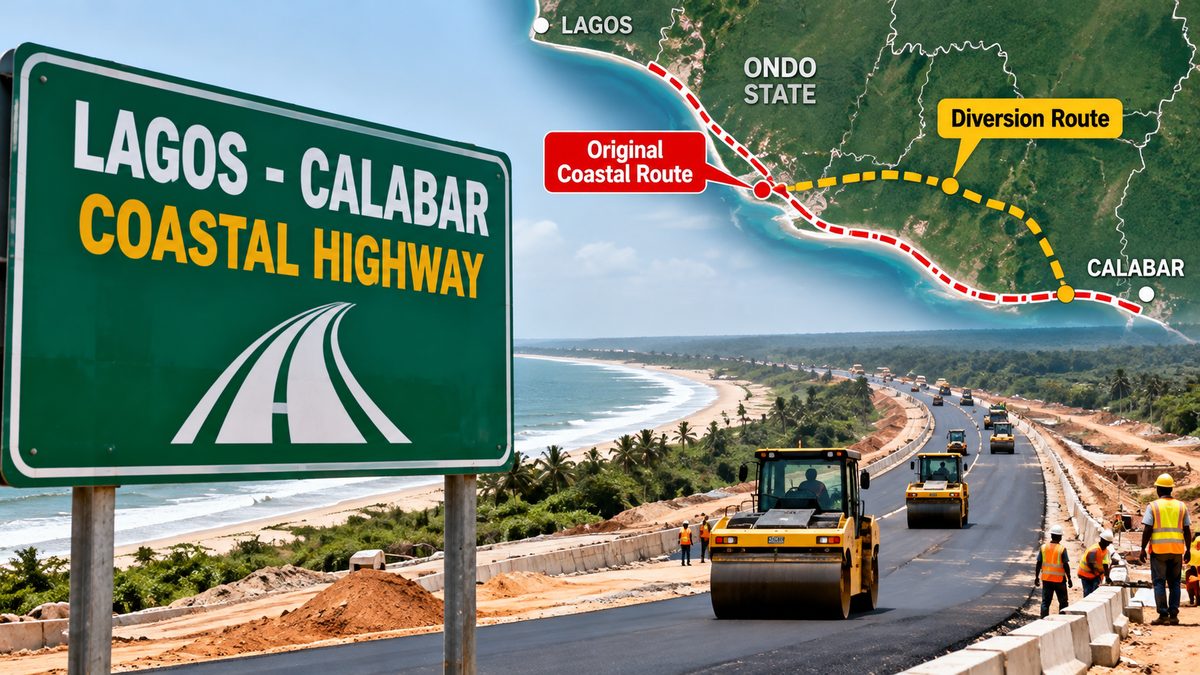
The Minister of Works, David Umahi, has defended the Federal Government’s decision to alter sections of the Lagos-Calabar Coastal Highway, insisting that the project remains intact despite growing criticism over the reported realignment.
Umahi said the engineering decisions taken on the project were necessary to address difficult terrain, rising construction costs and flooding concerns, dismissing suggestions that the administration had abandoned its original plan.
The minister made the clarification following a meeting with President Bola Tinubu at the Presidential Villa in Abuja on Monday, amid public controversy over the reported changes to sections of the highway.
In comments reported on Tuesday, October 13, Umahi maintained that the 750-kilometre coastal highway remained an ongoing project, with construction continuing on several sections while surveying and design work progressed on others.
According to reports by Premium Times and Punch Newspapers, the minister described claims that the government had abandoned the coastal highway in favour of the East-West Road as misleading.
Government Plans Additional 400km East-West Road Reconstruction
Umahi disclosed that the Federal Government had sought Tinubu’s approval to incorporate the reconstruction of approximately 400 kilometres of the East-West Road, extending from Edo State through the Niger Delta towards Akwa Ibom and Cross River states.
He explained that the additional road project was intended to address the recurring failure of sections of the existing East-West Road, which he said were constructed below flood level.
The minister maintained that reconstructing the East-West Road would not automatically mean abandoning the coastal highway, insisting that both projects were being pursued.
He also said surveying and design activities were continuing across Edo, Delta, Bayelsa and Rivers states to complete planning for the remaining sections of the coastal corridor.
Umahi Defends Ondo Route Changes
The controversy has been particularly pronounced in Ondo State, where questions have been raised about changes to the original route.
Umahi previously explained that parts of the original alignment presented significant engineering challenges, including deep pits, difficult subsoil conditions and a shortage of suitable sharp sand nearby.
He said the government redesigned sections of the route to avoid difficult terrain, reduce construction challenges and improve the durability of the highway.
The minister has defended the decisions, maintaining that the government has no regrets about the engineering choices made in Ondo State.
However, the explanation has not ended questions about whether the revised alignment will deliver the same benefits to communities along the coastline.
Atiku, Other Critics Demand Transparency
Former Vice-President Atiku Abubakar has criticised the reported route changes, demanding greater transparency concerning the project’s original design, revised alignment, contract terms and financial implications.
Atiku has called on the Federal Government to publish relevant feasibility studies, environmental assessments, revised designs and details of payments made to contractors.
He argued that Nigerians deserve to understand why changes became necessary after the project had been awarded and how those changes could affect the overall cost.
Concerns have also been raised by legal practitioners and other stakeholders over the potential consequences for coastal communities that were expected to benefit from the highway.
Senior Advocate of Nigeria Ebun-Olu Adegboruwa has called for clarification on the communities that will be served or bypassed by the revised alignment, warning that changes to the route could affect the project’s original economic objectives.
The Federal Government’s position, as conveyed by Umahi, is that the engineering adjustments are necessary and do not amount to abandoning the highway.
Project Progress and Outstanding Questions
Umahi has reported progress on several sections of the highway, including the Lagos, Ogun, Ondo, Akwa Ibom and Cross River axes.
He also said the 55-kilometre second section was expected to be ready by the middle of November 2026.
However, the controversy has shifted attention beyond construction progress to questions about the project’s final route, its cost and the communities expected to benefit.
While the government insists that the coastal highway remains intact, critics want the relevant technical and financial documents released to enable independent scrutiny of the decisions.
The central issue is therefore not only whether construction is continuing, but whether the revised alignment will preserve the project’s original objectives and whether the public will be given sufficient information to assess the changes.
Until the government publishes comprehensive details of the original and revised alignments, questions about the precise implications of the changes for coastal communities, project costs and contractual obligations are likely to persist.