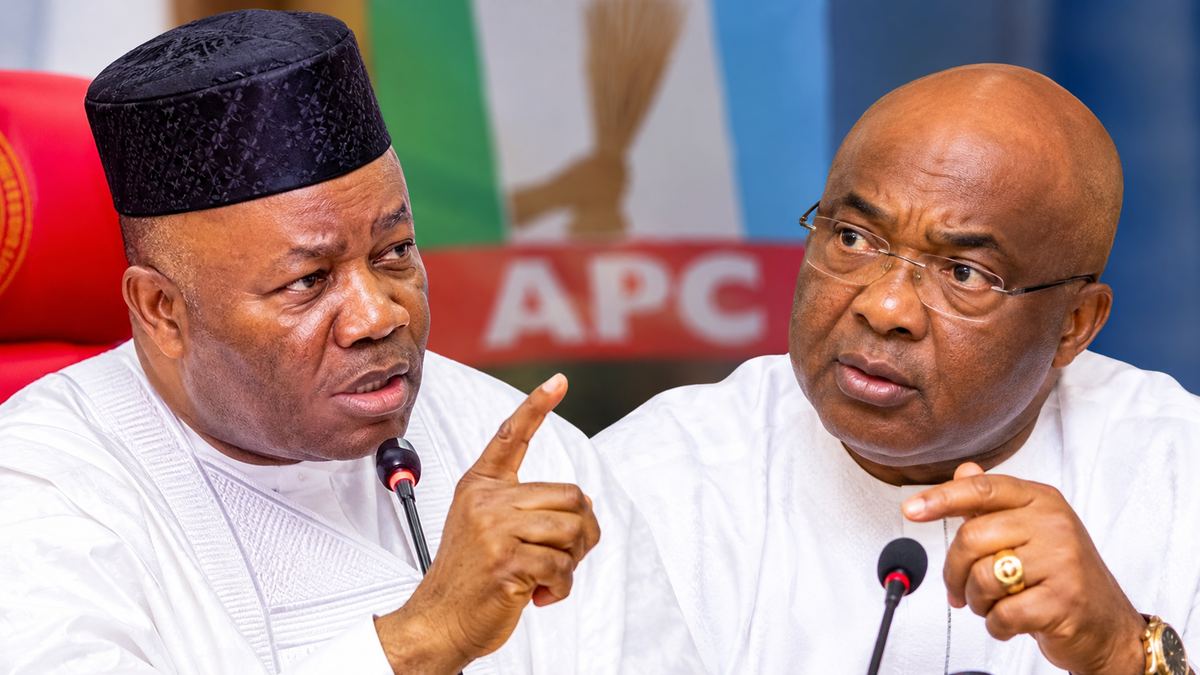
A political disagreement between Senate President Godswill Akpabio and Imo State Governor Hope Uzodimma has drawn attention following their remarks at the inauguration of the All Progressives Congress (APC) Presidential Campaign Council (PCC) in Abuja on Wednesday, October 14, 2026.
The exchange, which unfolded as party leaders gathered to prepare for President Bola Tinubu’s re-election campaign, has fuelled speculation about growing political competition ahead of the 2027 general elections, particularly over the leadership of the 11th National Assembly.
Although neither politician directly named the other in the relevant remarks, Akpabio’s comments about governors seeking other offices were widely interpreted as a warning directed at Uzodimma, who is contesting for the Imo West Senatorial District seat in the 2027 elections.
Akpabio Warns Governors Against Seeking Other Offices
Speaking at the event, Akpabio urged President Tinubu to support the return of the current National Assembly leadership, arguing that lawmakers had demonstrated their loyalty to the president and his administration.
The Senate President invoked a remark attributed to Anambra State Governor Chukwuma Soludo about the risks of changing an arrangement that was not broken.
He subsequently cautioned governors against abandoning their constituents in pursuit of other political positions.
“For my brothers who are governors, I want you to know that you must not abandon your people. I did eight years as a governor. The constitution says you should do eight years. There’s no need for you to start eyeing another position that is not available,” Akpabio said.
He also declared that he had been involved in politics for more than 25 years and had consistently won elections because, according to him, he stood with the people.
Akpabio’s remarks came amid reports that Uzodimma was positioning himself for a possible role in the leadership of the 11th Senate should he win his bid for the Imo West senatorial seat.
The Senate President’s appeal to Tinubu to support the return of the current National Assembly leadership has further drawn attention to the political calculations surrounding the next Senate presidency.
Uzodimma Emphasises Unity and Collective Responsibility
In his remarks, Uzodimma, who chairs the Progressive Governors Forum and serves as secretary of the APC Presidential Campaign Council, stressed the need for party leaders to reconcile their differences and work together ahead of the elections.
He argued that the electoral fortunes of the president and other APC candidates were interconnected, warning against complacency among party members.
“Mr President will be on the ballot on 16 January 2027, but if we are honest with ourselves, so will we,” Uzodimma said.
The governor explained that the election would serve as a referendum not only on Tinubu’s administration but also on the performance of APC governors, lawmakers and other elected officials seeking re-election.
He urged party leaders to put aside grievances arising from internal disagreements and rally behind the party’s candidates.
“We must reconcile any differences we may have and rally as one family behind the party and all our candidates. We must speak to Nigerians as one family with one voice and one message,” he said.
Uzodimma also maintained that the party’s performance at the polls would depend partly on what voters had experienced under their elected representatives.
His comments placed emphasis on grassroots performance and collective responsibility as the APC prepares for the 2027 general elections.
The 2027 Senate Presidency Calculation
The underlying political significance of the exchange lies in the anticipated contest for leadership of the 11th National Assembly.
Akpabio is seeking to retain the Senate presidency after the 2027 elections, while Uzodimma’s senatorial ambition has generated speculation about whether the Imo governor could eventually emerge as a contender for the position.
However, winning a senatorial seat would not automatically make Uzodimma Senate president. The position would depend on the composition of the incoming Senate and the outcome of the senators’ internal leadership contest.
Akpabio’s appeal to Tinubu to support the return of the current National Assembly leadership therefore comes against the backdrop of political manoeuvring ahead of the next legislative session.
Nevertheless, neither Akpabio nor Uzodimma explicitly declared at the PCC inauguration that the exchange was a personal confrontation over the Senate presidency.
The interpretation that their remarks reflected a struggle for the position is based on the political circumstances surrounding Akpabio’s re-election ambition and Uzodimma’s senatorial bid.
APC Unity Under the Spotlight
The exchange has also raised questions about the ability of APC leaders to maintain a united front while managing competing political interests ahead of the 2027 elections.
Uzodimma’s call for reconciliation came at an event where party leaders were expected to demonstrate unity behind Tinubu’s re-election campaign.
Akpabio, meanwhile, used his address to seek support for the continuation of the current National Assembly leadership and to caution governors against pursuing other political offices.
Both interventions highlighted the relationship between the presidential campaign, the ambitions of individual politicians and the internal arrangements that will shape the next National Assembly.
With the elections approaching, the APC faces the task of balancing its public message of unity with the competing ambitions of influential party figures.
Whether the differences reflected in Wednesday’s remarks develop into a more open political contest remains to be seen.
For now, the exchange has brought the question of the 11th Senate presidency into sharper focus, even as the ruling party begins organising its campaign for the 2027 general elections.