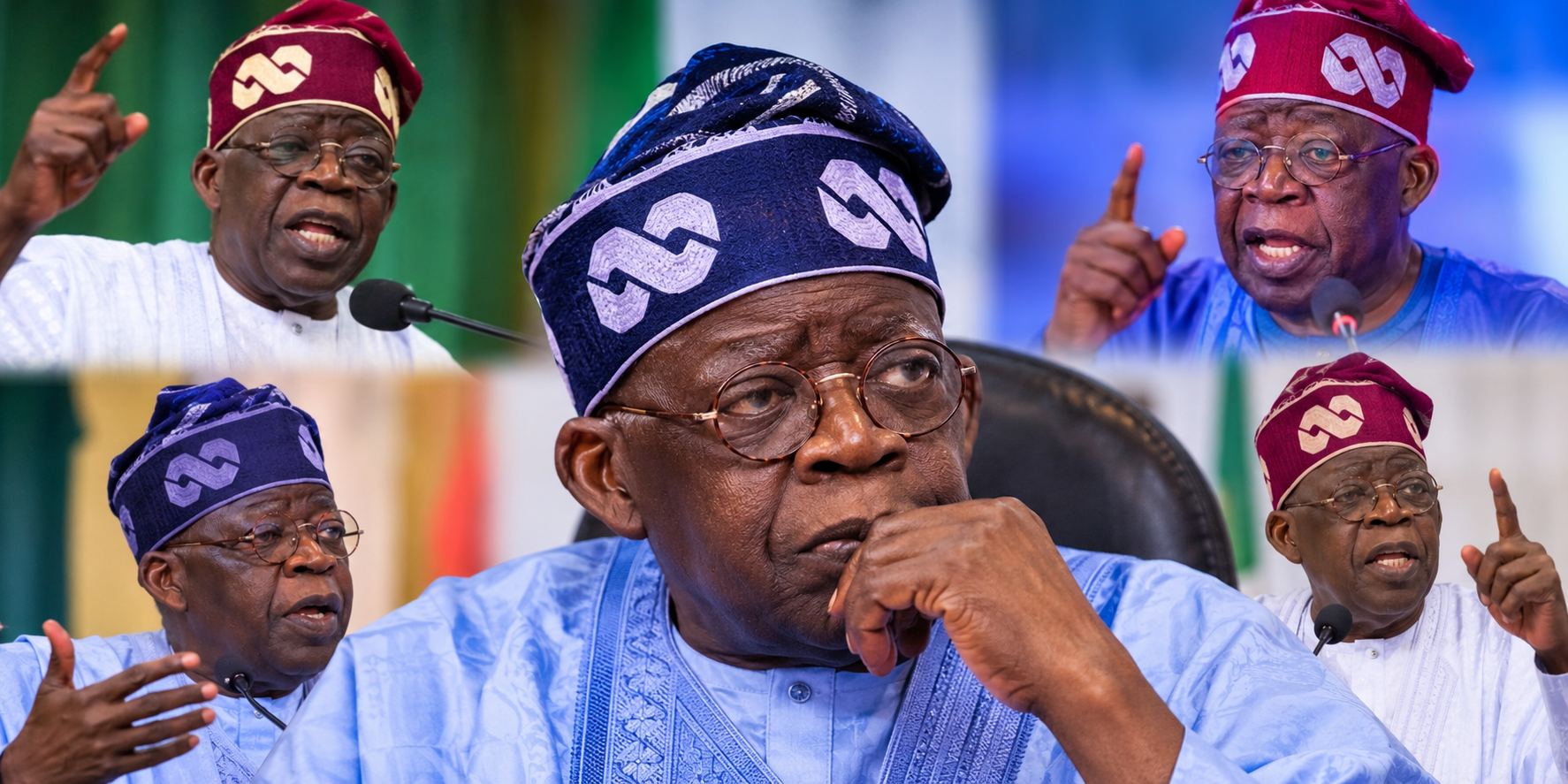
President Bola Ahmed Tinubu’s verbal slip at the inauguration of the All Progressives Congress (APC) Presidential Campaign Council for the 2027 general election has revived memories of the controversial remarks that trailed his presidential campaign in 2022 and 2023.
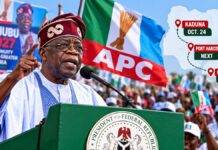
Tinubu, who is seeking re-election in 2027, appeared to mistakenly refer to himself as a governor rather than president while addressing party leaders and members of the campaign council at the Banquet Hall of the Presidential Villa in Abuja on Wednesday, October 14, 2026.
While acknowledging party leaders and other dignitaries, the president said the campaign council’s Director-General would help bring “Governor Bola Tinubu back for second time” before appearing to correct himself and refer to “President Bola Tinubu”.
The remark quickly attracted attention because Tinubu had served as governor of Lagos State between 1999 and 2007 before becoming president in May 2023.
Although the incident could be an ordinary slip of the tongue, it recalls several moments during his presidential campaign when his public statements became subjects of national debate, online jokes and political criticism.
‘Bala Blu, Blu Bulaba’: The Unforgettable Campaign Moment
One of the most widely circulated incidents occurred in November 2022 during a meeting with members of the business community in Imo State.
Tinubu used the expression “balablu, blu bala, bula ba” while discussing the nature of a town hall meeting and responding to questions surrounding his participation in such engagements.
The phrase quickly became a popular subject of political satire, with opposition supporters using it to question his public speaking.
The incident also triggered controversy after Dele Alake, a senior member of Tinubu’s campaign team at the time, claimed that the viral video had been doctored.
However, a fact-check by the Centre for Democracy and Development’s Election War Room found that the original broadcast by Television Continental captured Tinubu making the remark, contradicting the claim that the incident had been fabricated through video manipulation.
The episode demonstrated how a brief moment during a campaign could overshadow a politician’s broader message.
‘Emi Lokan’: The Remark That Defined His Presidential Ambition
Another memorable moment occurred on June 3, 2022, during a political gathering in Abeokuta, Ogun State, ahead of the APC presidential primary.
Tinubu declared “Emi lokan”, a Yoruba expression meaning “it is my turn”, while making the case for his presidential ambition.
He also criticised then-President Muhammadu Buhari’s unsuccessful attempts to win the presidency before his eventual victory in 2015.
The statement became one of the defining slogans of Tinubu’s campaign. Supporters interpreted it as an assertion of his political experience and contribution to the APC’s rise to power, while critics questioned the sense of entitlement they believed the remark conveyed.
Unlike the “Bala Blu” episode, “Emi lokan” was not an unintelligible statement. It was a deliberate political declaration whose interpretation differed sharply between supporters and opponents.
The phrase nevertheless became a recurring feature of political discussions surrounding Tinubu’s ambition and his eventual emergence as president.
The ’50 Million Youths’ Controversy
Tinubu also attracted attention over a statement made during his 69th birthday colloquium in Kano on March 29, 2021.
While discussing employment opportunities and agricultural production, he was widely quoted as proposing the recruitment of 50 million youths into the Nigerian Army, with food production involving crops such as maize and cassava.
The statement generated criticism because of the enormous scale of the proposed recruitment and the apparent connection between military employment and agricultural consumption.
The controversy became another example of how his public remarks could generate debate beyond the immediate subject of his speech.
However, the figure circulated in discussions of the incident has also been disputed. Some accounts have maintained that he intended to refer to 50,000 youths rather than 50 million.
Consequently, the statement should be examined in its original context rather than treated as conclusive evidence of a policy proposal to recruit 50 million people into the military.
The Alleged Atiku-Anambra Gaffe: A Case of Misinformation
Not every viral clip attributed to Tinubu during the 2023 campaign accurately represented what he said.
In January 2023, a video circulated on social media suggesting that Tinubu had referred to his rival, Atiku Abubakar, as a former governor of Anambra State.
The claim attracted ridicule and was presented as another example of a verbal mistake.
However, AFP Fact Check examined the recording and found that an audio glitch appeared to have altered the meaning of the speech. Other footage and transcripts indicated that Tinubu was referring to Peter Obi, the former governor of Anambra State, rather than Atiku.
The episode highlights an important distinction between a genuine verbal slip and a misleading clip that changes the meaning of a politician’s words.
The London Teleprompter Controversy
During the 2023 presidential campaign, Tinubu also faced public scrutiny over his use of a teleprompter during an engagement in London.
The incident generated debate over his communication style and his ability to respond to questions in public settings.
Critics questioned the extent to which the candidate relied on prepared remarks, while his supporters could argue that using prepared speeches and presentation aids is not unusual in political communication.
The episode became part of the wider conversation about his public appearances during the election campaign.
Nevertheless, the use of a teleprompter is not, in itself, evidence of a verbal gaffe or an inability to perform presidential duties.
From Campaign Controversies to the Presidency
Tinubu eventually won the February 2023 presidential election and was inaugurated as Nigeria’s president on May 29, 2023.
His campaign-era remarks had generated considerable attention, but their political significance remains open to interpretation.
For supporters, the controversies were often exaggerated by political opponents and social media users who focused on isolated moments rather than his political record and policy proposals.
For critics, the incidents raised questions about the clarity of his public communication, particularly during a campaign in which voters expected candidates to articulate their plans for the country.
The distinction matters because a verbal slip, a controversial political slogan, an inaccurate statement and a manipulated video are not the same thing.
Each requires its own context and evidence.
What the Latest Gaffe Means for the 2027 Campaign
Tinubu’s apparent reference to himself as “Governor Bola Tinubu” at Wednesday’s APC campaign council inauguration has provided fresh material for political commentary as preparations for the 2027 election gather momentum.
The incident is particularly notable because the president is seeking another four-year term after more than three years in office.
However, one verbal slip does not establish a broader conclusion about a politician’s competence, health or capacity to govern. Those questions require evidence beyond isolated speech errors.
The more consequential test for the president will be whether his administration can demonstrate measurable progress on economic hardship, inflation, employment, insecurity and the living conditions of Nigerians.
As the 2027 campaign develops, Nigerians will have opportunities to assess the president’s record, scrutinise his promises and compare the positions of the competing candidates.
Ultimately, the election debate should extend beyond memorable phrases and campaign controversies to include verifiable records, policy commitments and the results of governance.