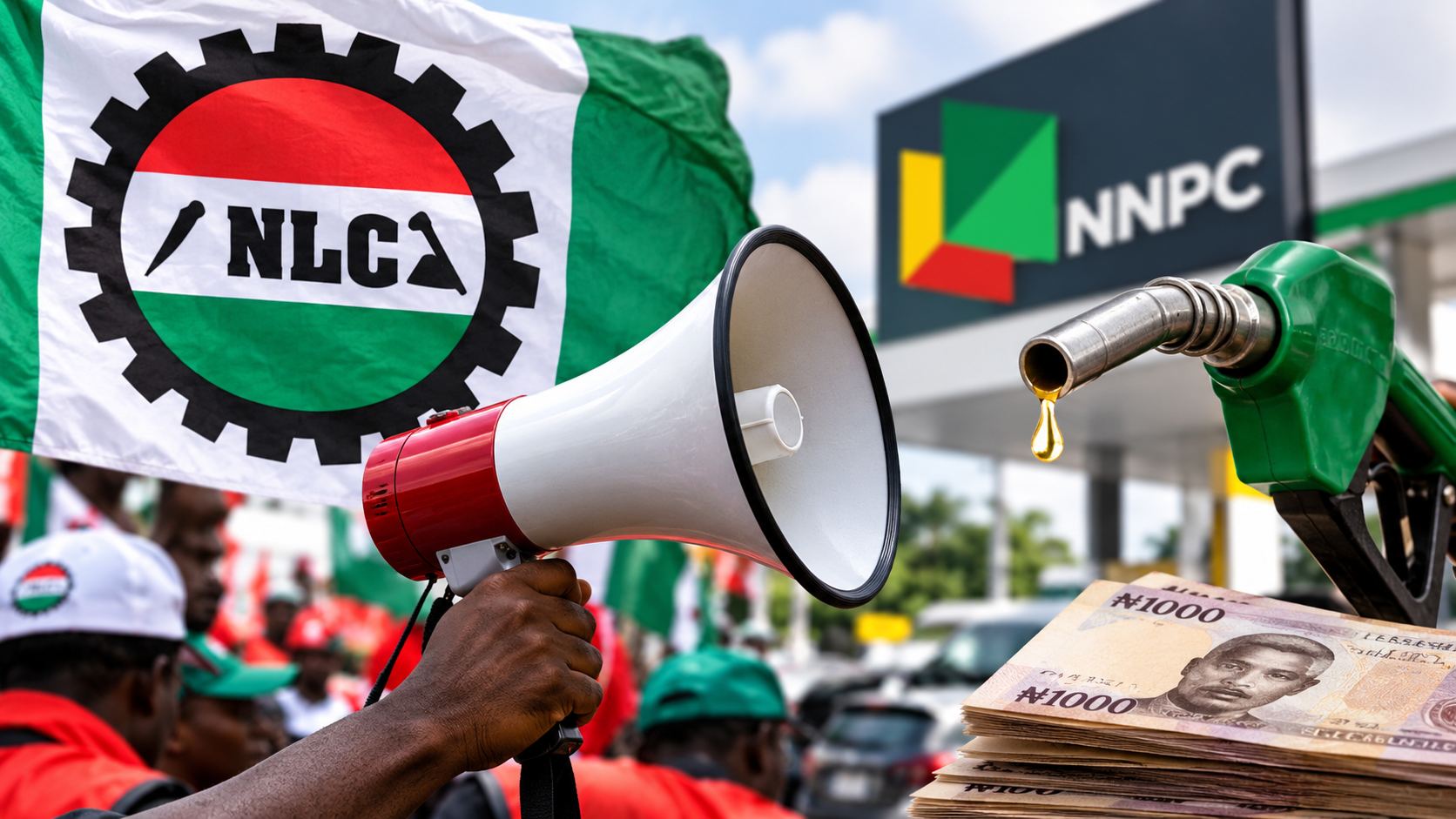
The Nigeria Labour Congress (NLC) has rejected the Federal Government’s position on the timing of negotiations for a new national minimum wage, intensifying tensions between organised labour and the government over workers’ welfare and the rising cost of living.
The development raises the possibility of an industrial confrontation as the labour union presses for an immediate reduction in petrol prices, tax relief for workers and the commencement of negotiations for a new minimum wage.
In a report published on Thursday, October 15, the Vanguard newspaper disclosed that the NLC had faulted the government’s response to its demands, insisting that preparations for a new wage agreement should begin without further delay.
The dispute followed a 14-day ultimatum issued by the labour congress on October 8, giving the Federal Government until October 22 to address its demands.
Although the NLC has warned that it could take further action if the government fails to respond satisfactorily, it has not formally announced a nationwide strike.
Why the NLC Is Demanding a New Minimum Wage
The NLC argues that the current national minimum wage of ₦70,000 has been eroded by rising living costs, leaving many Nigerian workers struggling to meet their basic needs.
The union maintains that increases in the prices of food, transportation, housing, healthcare and other essential commodities have significantly weakened workers’ purchasing power.
It has therefore called on the Federal Government to commence negotiations for a new minimum wage before the end of October 2026.
According to the labour congress, beginning negotiations early would give the government, employers and organised labour sufficient time to reach an agreement before the next wage arrangement becomes necessary.
The NLC insists that its immediate demand is for negotiations to begin, rather than for the instant implementation of a new minimum wage.
FG Insists Minimum Wage Review Is Not Yet Due
The Federal Government, however, maintains that an immediate review of the current minimum wage would be premature.
In its response to the labour congress, the Ministry of Labour and Employment argued that the existing ₦70,000 minimum wage, signed into law in July 2024, would become due for review on June 1, 2027.
The government cited the statutory provision for a three-year minimum wage review cycle, arguing that commencing another review before the stipulated period would be inconsistent with the law.
It also pointed to existing interventions, including the Presidential Compressed Natural Gas (CNG) Initiative, food security programmes and other social support measures, as efforts to cushion the effects of economic hardship.
The government said it remained committed to dialogue with organised labour and would convene the National Minimum Wage Tripartite Committee at the appropriate time.
However, the NLC has rejected this interpretation, arguing that preparations for a new wage agreement should begin well before the current arrangement reaches its review date.
The disagreement has consequently shifted from the question of workers’ economic difficulties to a dispute over the legal timetable for commencing another minimum wage negotiation.
NLC Demands Petrol Price Reduction
Beyond the minimum wage dispute, the labour congress has called for a reduction in petrol prices to the level prevailing when the current minimum wage was signed into law in 2024.
The union argues that high fuel prices have contributed to increased transportation costs and pushed up the prices of food and other essential goods.
It maintains that workers cannot enjoy meaningful wage improvements when increases in earnings are offset by rising living expenses.
The NLC has also demanded the implementation of tax relief measures previously agreed upon with the government, as well as immediate wage awards to cushion the impact of the rising cost of living.
Other demands include the implementation of outstanding agreements with the Joint Health Sector Unions and the resolution of issues raised by the Joint Public Sector Negotiating Council.
The union warned that failure to address these concerns within the ultimatum period could compel it to consider further action.
What a Strike Could Mean for Nigerians
A nationwide strike by organised labour could disrupt public services and economic activities, depending on the scope of participation by affiliated unions.
Government offices, public institutions and other essential services could experience disruptions if negotiations fail and the labour congress directs its members to embark on industrial action.
Businesses could also face additional operating challenges if a strike affects transportation, public administration or other key economic activities.
For workers, however, the dispute centres on the ability of their earnings to meet basic household expenses amid persistent economic pressures.
The government faces the challenge of balancing labour demands for immediate relief against its position on the statutory timetable for reviewing the national minimum wage.
Whether the two sides can reach a compromise before the ultimatum expires will be crucial in determining the next phase of the dispute.
Dialogue or Industrial Confrontation?
The latest disagreement underscores the continuing tension between organised labour and the Federal Government over the effects of economic policies on Nigerian workers.
While the government insists that the next minimum wage review should follow the statutory timetable, the NLC argues that negotiations must begin early enough to prevent delays and protect workers’ purchasing power.
The two sides have therefore maintained opposing positions on when negotiations should commence and what immediate relief measures should be introduced.
With the NLC’s ultimatum approaching its reported deadline of October 22, attention is now focused on whether further engagement will produce a resolution.
For now, the prospect of a nationwide strike remains a possibility rather than a confirmed decision, as the outcome will depend on the government’s response and the labour congress’s subsequent actions.
Polity Nigeria will continue to monitor developments in the dispute and report any official decisions concerning the ultimatum and possible industrial action.